Inspiration
We Have A Number Of Sources Of Solutions Thant Should Prove Inspirational For You.
Inspiration
We Have A Number Of Sources Of Solutions Thant Should Prove Inspirational For You.
High quality standard and bespoke outdoor living products designed to create additional beautiful outdoor space protected from the often great, but extremely variable British weather.
By Product Type
Get In Touch
With Us Today
Samson Awnings offer a vast range of fixed or Retractable Awnings, commercial Retractable Canopies, Glassrooms, Parasols, External Vertical Blinds and Freestanding Structures to protect from the UK weather and extend the use of your outdoor space all year round.
By Product Type
Get In Touch
With Us Today
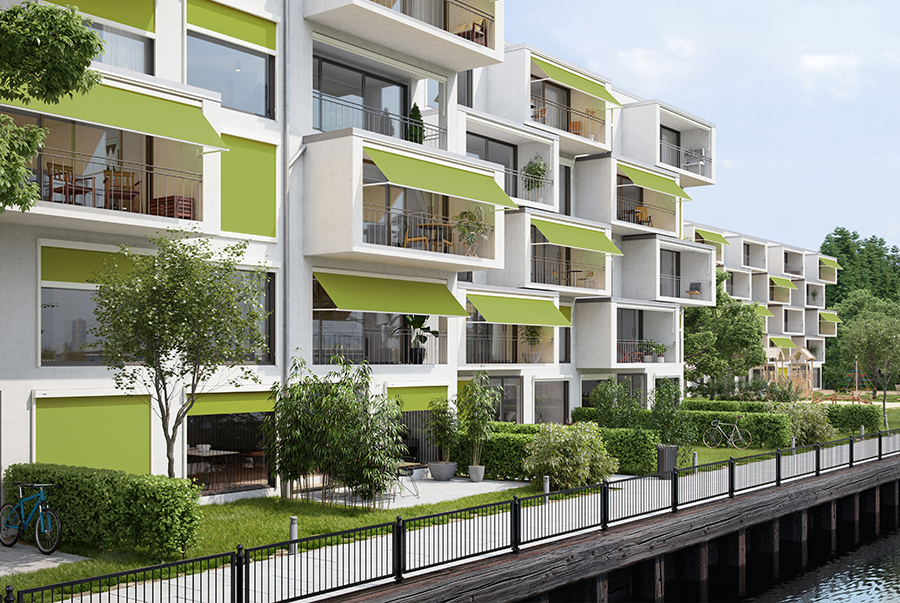
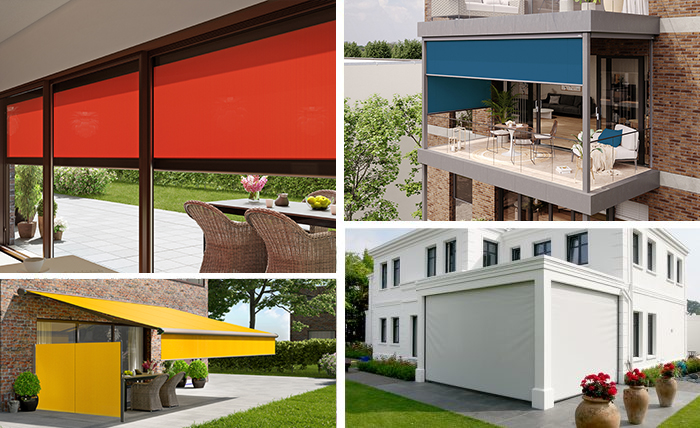
Summer 2026 has provisionally been confirmed as the UK’s hottest on record, with a mean temperature of 16.5°C across June, July and August, the warmest summer in records dating back to 1884. It was also the first UK summer in which every month recorded temperatures above 35°C.
For many homeowners and businesses, the issue was not simply enjoying the sunshine.
Large patio doors, bifold glass doors, roof glazing and wide windows will admit substantial solar heat and glare, making rooms uncomfortable just when they should be most enjoyable.
Autumn and Winter is an ideal time to plan professionally specified external shading, ready for the next period of hot weather. Lower prices can be obtained and many special offers from manufacturers are usually available too, before the usual price increases in early spring, around February.
Stop heat before the glass
External shading works differently from internal curtains and blinds. It is positioned outside the glazing, intercepting sunlight before it passes through the glass and adds to the heat inside.
Recent testing at Loughborough University’s matched full size test houses found that external shading could reduce indoor temperatures by more than 6°C in certain conditions. The findings underline the role of external shading as a practical passive cooling measure, although real world performance will vary according to the building, glass area, orientation, product design and how it is used.
This does not mean that one awning is suitable for every window or door. The most effective solution depends on where the sun reaches the property, the amount of glazing, the required projection or drop, wind exposure and whether the priority is shade, glare control, privacy or all three.
Why plan in autumn?
Planning external shading after summer provides the benefit of direct experience: homeowners can identify which rooms overheated, when glare was at its worst, and which doors or windows became uncomfortable to use.
It also allows time for proper product selection, survey, manufacture and professional installation before spring and summer demand returns. Rather than making a rushed choice during a heatwave, a survey can establish the right system for the size and position of the glazing.
For commercial sites, autumn is also the sensible period to review how customer-facing spaces performed during summer. Cafés, restaurants, offices, schools, care settings, retail premises and hospitality venues may all benefit from reducing glare and solar gain around large areas of glass.
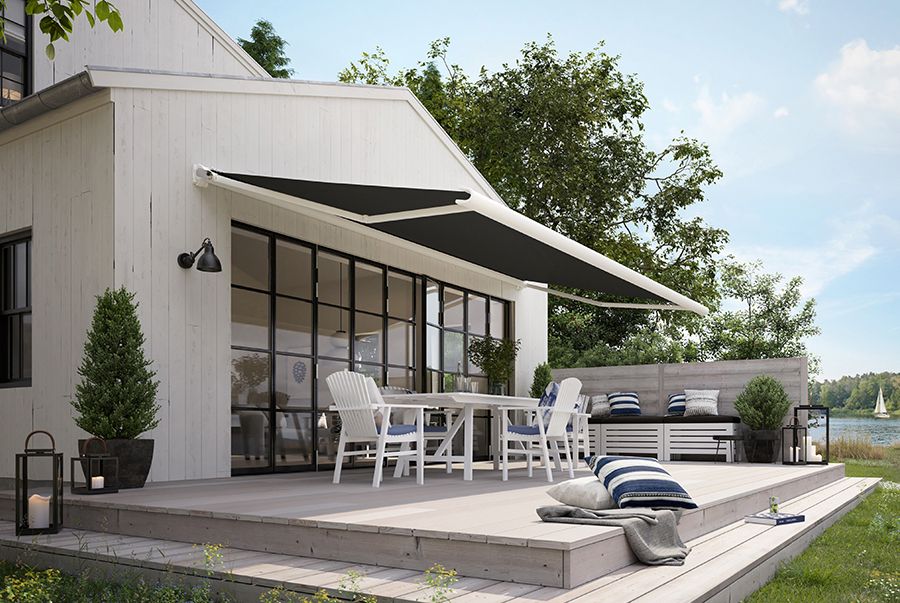
Folding arm awnings for doors
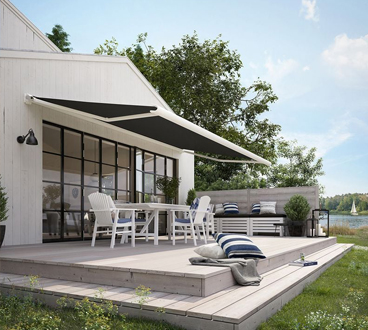
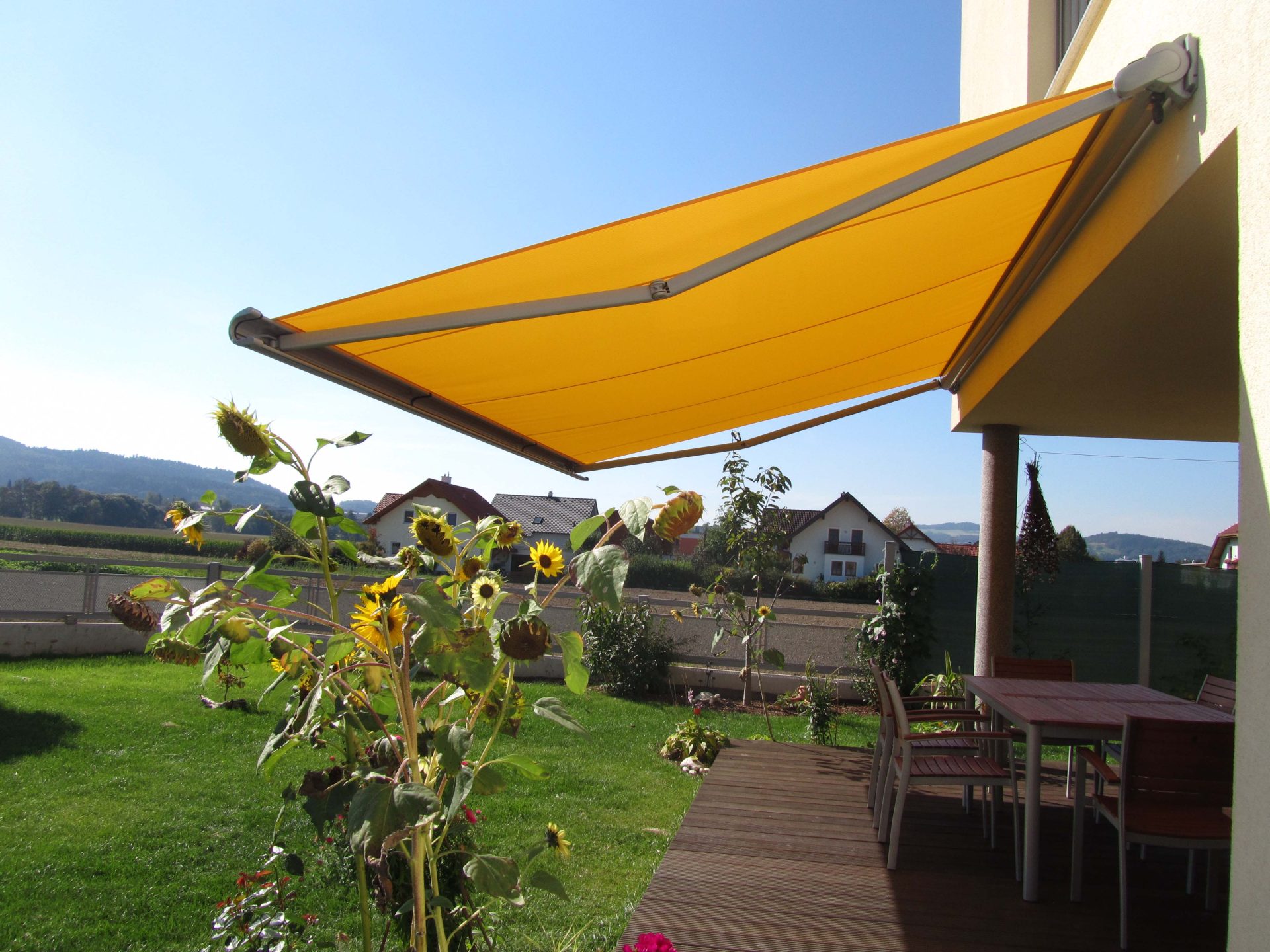
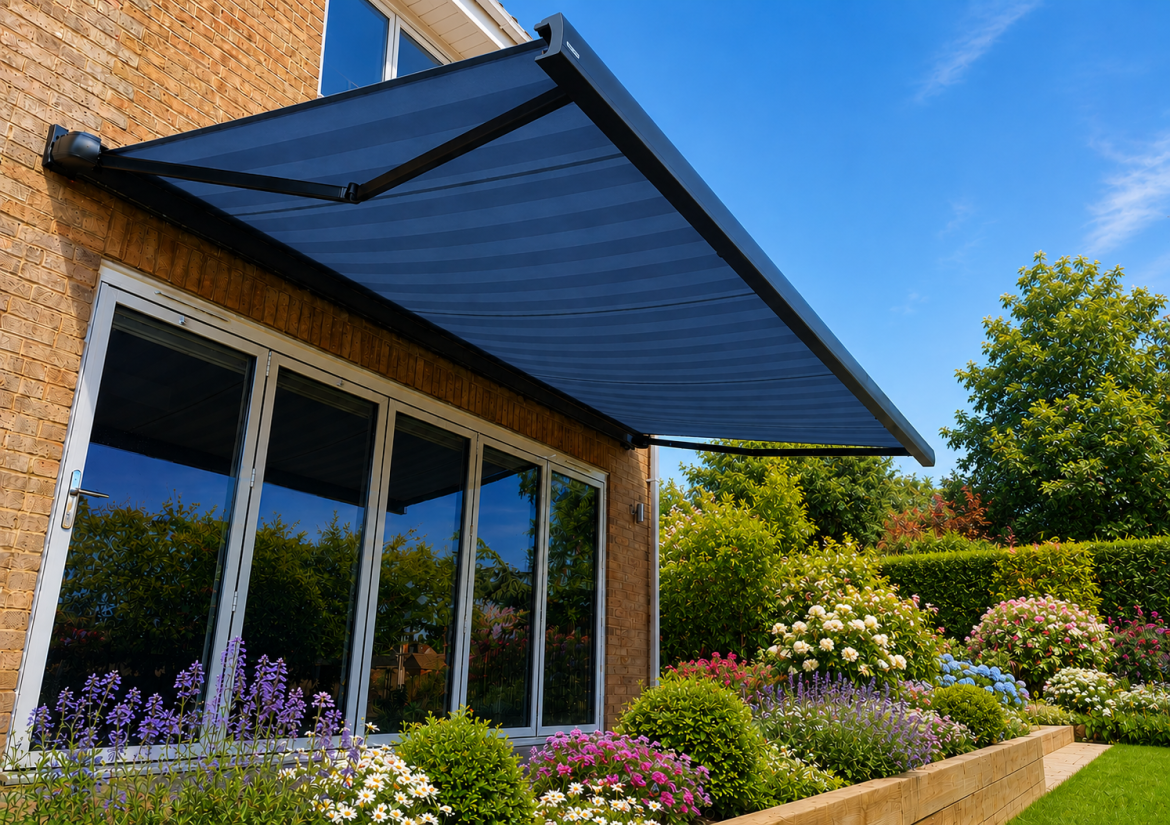
Retractable folding arm awnings are often the natural choice above patio doors, French doors, bifolds and sliding doors. When extended, they create broad horizontal shade over the glass and the immediate terrace area; when the sun has moved or the weather changes, they retract neatly back towards the building.
A made-to-measure folding-arm awning can be specified for the available wall width and the required projection. This is important: a wide area of bifold doors may need a generous projection to create meaningful shade when the sun is high, while west-facing doors may need consideration of lower late-afternoon sun and glare.
They are particularly well suited to:
– Bifold and sliding patio doors opening onto a terrace.
– South- and west-facing glazed extensions.
– Kitchen-diners with large areas of rear glazing.
– Balconies and smaller patios where a permanent roof is not required.
– Restaurant, café and pub terraces where flexible overhead shade is needed.
Folding arm awnings are primarily solar shading products. They should be retracted in unsuitable wind conditions and should not be treated as storm protection. Automation such as wind sensing and sun control can help the awning respond appropriately, but a product should always be selected and operated in line with its specific technical guidance.
Click HERE for further information >
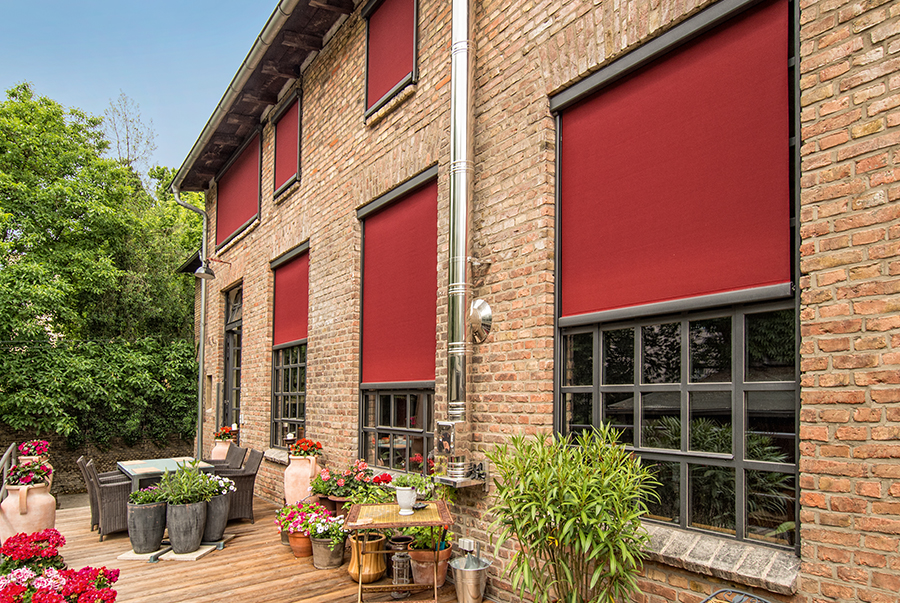
External vertical blinds for glazing
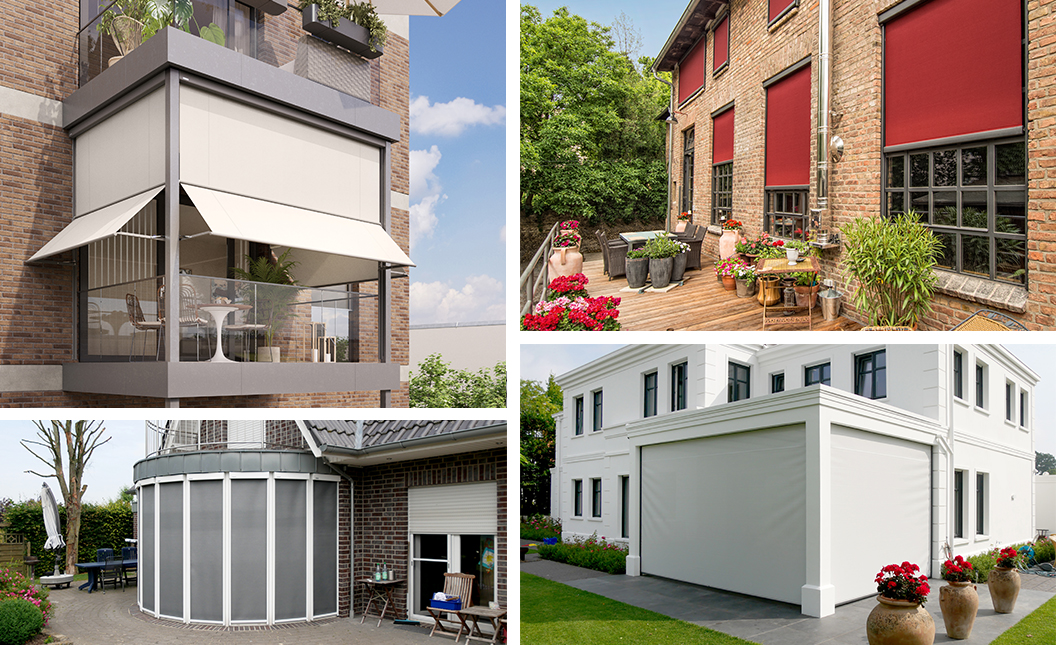
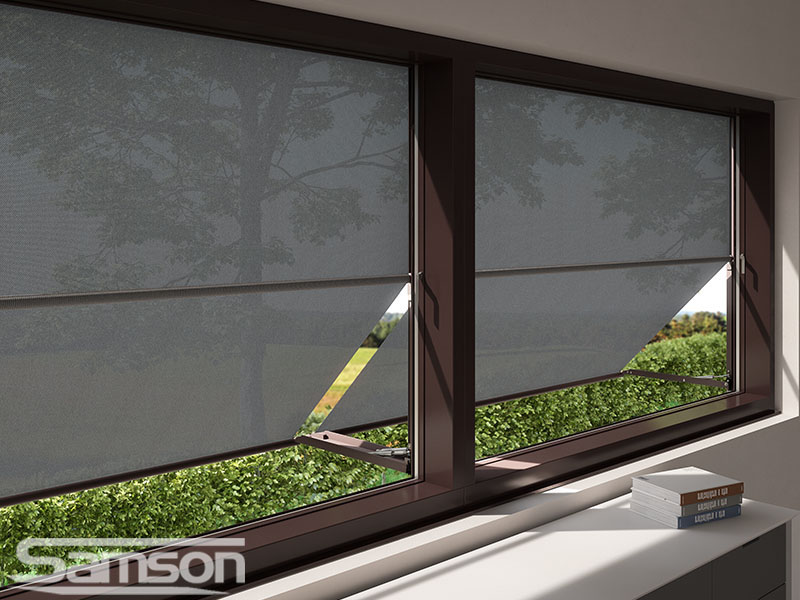
External vertical blinds, commonly known as external screens, zip screens or façade blinds depending on the system are designed to shade the face of a window, glazed wall or door opening. They are particularly effective where the problem is low angle sun, glare or privacy rather than creating a covered terrace. In Europe these are growing in popularity over most other external shading products and we are not waking up yet in the UK to the overall benefits.
A vertical external blind can be lowered in front of wide doors and windows to filter sunlight before it reaches the glass. Depending on the fabric selected, it can retain a degree of daylight and outward view while reducing glare and solar gain.
They are an excellent option for:
– West facing doors affected by late afternoon and evening sun.
– East facing bedrooms, offices and kitchens exposed to early sun.
– Floor to ceiling windows and large glazed elevations.
– Home offices where screen glare affects work and video calls.
– Commercial façades, shopfronts, offices, schools and care settings.
– Properties needing daytime privacy without closing heavy internal curtains.
The fabric openness, colour and guide system matter. A more open screen fabric can preserve a clearer view out; a denser fabric offers stronger glare and privacy control. A professional survey should also consider fixing positions, wind exposure, the dimensions of the opening and whether the screen is intended mainly for solar control, privacy or both.
Click HERE for further information >
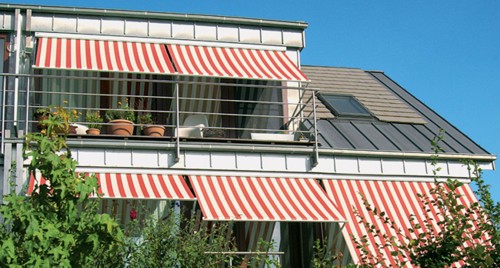
Drop Arm awnings for windows
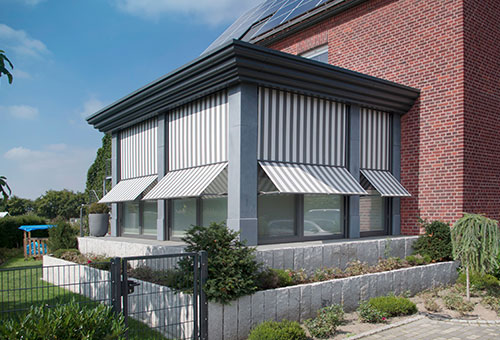
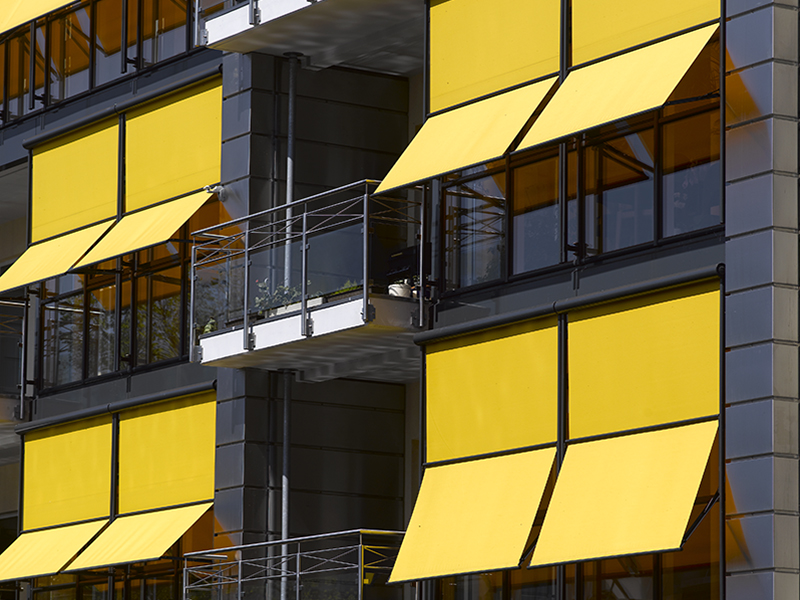
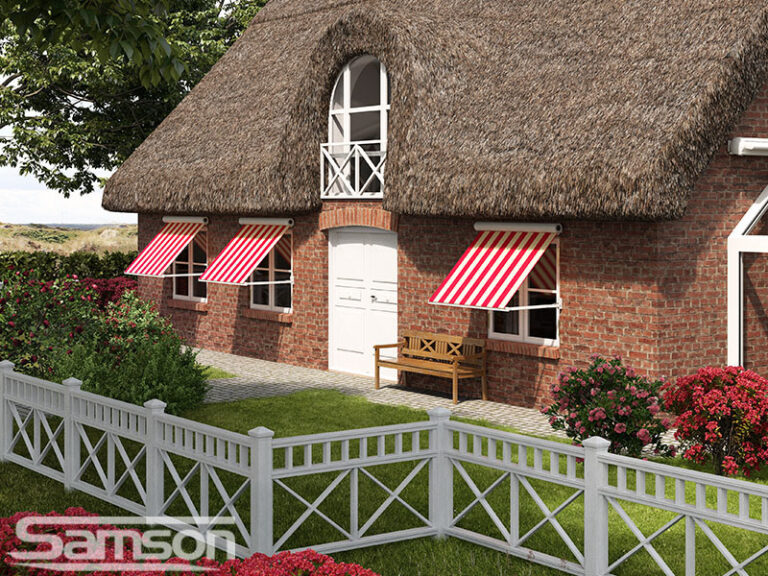
Drop arm awnings offer another very valuable form of external window shading. Rather than projecting horizontally over a terrace, they are mounted above a window and extend downwards at an angle to shade the glass while allowing air movement and daylight beneath the awning.
They are particularly suited to upper floor windows, bay windows, offices, bedrooms, conservatories and façades where a conventional patio awning would not be appropriate. Their angled position can be especially useful when the sun is lower in the sky, such as morning or late afternoon.
Click HERE for further information >
Typical applications include:
– South, east and west facing windows.
– Bedrooms that become uncomfortable in early morning or late day sun.
– Home offices and commercial workspaces.
– Shopfronts and customer facing windows.
– Schools, care homes and public buildings with repetitive window elevations.
– Homes where external shading is wanted without covering the patio.
Drop arm awnings can also enhance the appearance of a property. With the right fabric and frame colour, they add a considered architectural feature while providing useful, adjustable shade across the glazing. They have a greater resistance to wind and rainfall because of their steep angle and the side arms holding the front profile steady.
Match the product to the problem
| Requirement | Most suitable starting point | Why |
| Shade across patio doors and terrace seating | Retractable folding arm awning | Creates broad horizontal cover over doors and outdoor living space |
| Reduce glare and solar gain through wide glazing | External vertical blind or zip screen | Shades the glass directly, including when the sun is low |
| Shade individual windows but retain ventilation and vision | Drop arm awning | Projects out from the window at an angle, allowing light and airflow beneath |
| Control late afternoon sun through west facing doors | External vertical blind, sometimes paired with a folding arm awning or a drop down valance system | Vertical shading deals more effectively with low angle sunlight |
| Shade a large hospitality terrace | Commercial folding arm awning, supported pergola or bespoke system | Provides flexible cover, subject to site layout, wind exposure and permissions |
| Improve comfort in offices, schools or care settings | External vertical blinds or drop arm awnings | Provides façade level glare and solar control across windows |
A practical passive cooling measure
External shading should be part of a broader approach to managing hot weather. Window orientation, glazing, ventilation, insulation, night-time cooling, room use and landscaping can all influence comfort.
However, shading the outside of glazing is one of the most direct ways to reduce solar heat before it builds up indoors. The Met Office says the record breaking summer was made around 130 times more likely by human induced climate change, making heat resilience an increasingly relevant consideration for homes and commercial buildings alike.
Samson Awnings supplies and installs made to measure external shading for homes and commercial properties, including retractable folding arm awnings, external vertical blinds and drop arm awnings. A survey allows the correct system to be selected around the size of the glazing, sun path, required coverage, exposure and the appearance of the building.
Planning this autumn means your property can be better prepared for spring and summer 2027.









UK summers are becoming warmer, sunnier and more challenging for homes with large windows, patio doors and glazed extensions. It is a problem many homeowners already recognise: rooms that feel pleasant in spring can become uncomfortably hot once strong sunshine reaches the glass.
Closing curtains or internal blinds may help reduce glare and improve privacy, but they begin working only after sunlight has reached — and started warming — the glass. For the most effective defence against unwanted solar heat, shade should be positioned outside the window or door, stopping much of the sun’s energy before it enters the home.
Why Internal Blinds Have Limits
Internal blinds, shutters and curtains still have a role. They are useful for privacy, light control and reducing glare, and can make a room feel more comfortable.
However, they are not the strongest solution for a room overheating in direct sunshine. Once solar radiation has passed through the glazing, heat is already being introduced to the room. An internal blind can absorb or reflect some of that energy, but it is doing so from inside the building.
External shading works earlier in the process. By intercepting sunlight before it reaches the glass, it reduces the solar gain that can build up indoors. Internal systems can contribute to solar control, but external or mid-pane solutions are generally more effective at limiting overheating.
Stop Heat Before It Reaches the Glass
This is the simple advantage of external shading: it treats the cause rather than trying to manage the effect.
A well-designed awning, external blind or pergola can shade glazing at the time it matters most, helping rooms stay more comfortable during sunny periods. The precise result will vary from one home to another, depending on the direction the windows face, the size and type of glazing, the shading fabric, the level of coverage and how the system is used.
External shading should not be viewed as a one-size-fits-all solution or a universal temperature guarantee. It is better understood as a practical way to substantially reduce unwanted solar gain. Awnings, external blinds, shutters and overhangs are all recognised approaches to controlling summer heat in homes.
The Right System for Each Space
External shading is not one product. Different systems suit different elevations, lifestyles and types of glazing.
Retractable Awnings
Retractable awnings are particularly effective over patio doors, French doors, bifold doors and wide south or west facing windows. They project outward with folding arms to create shade over the glass and, at the same time, make patios and terraces more comfortable for dining, relaxing and entertaining.
Because they retract when not required, an awning gives homeowners control: welcome sunlight in cooler weather, then extend shade when the sun becomes intense.
Pergola Systems
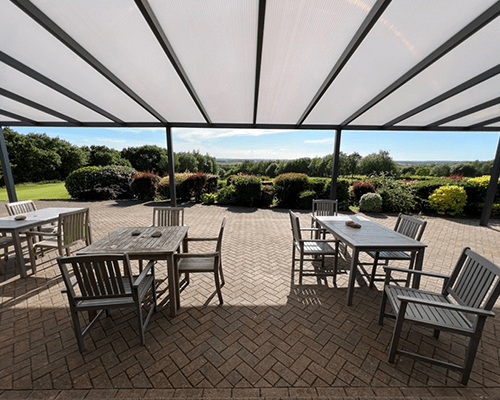
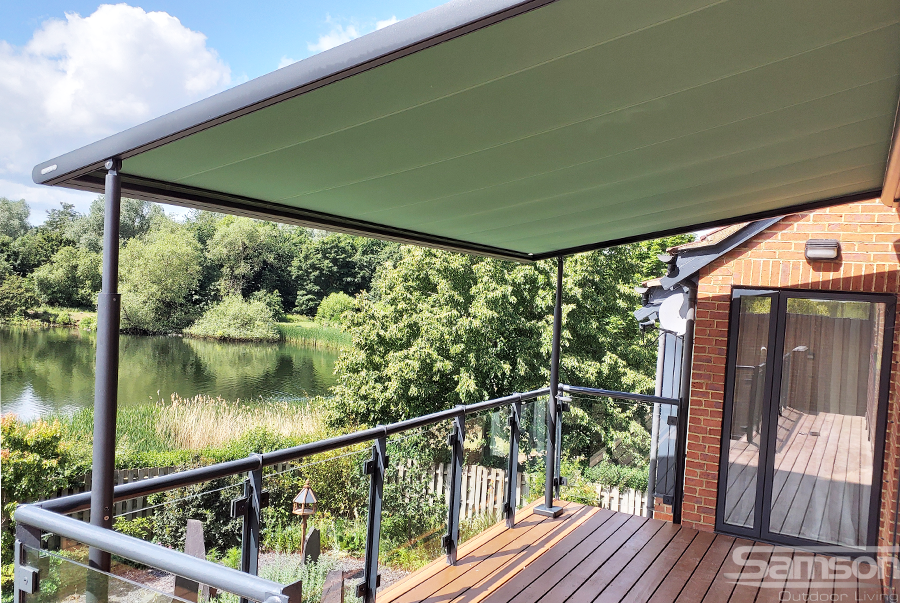
Pergolas are ideal where the objective is to improve both indoor comfort and outdoor living. Positioned beside large glazed doors or across a terrace, they create a defined shaded area that can help reduce direct sun on the home while making the garden more usable throughout the warmer months.
Retractable fabric roof pergolas can offer a more architectural, all season solution, although the correct design will depend on the space, exposure and intended use. High tension fabric roof systems are ideal if you also want to protect from rainfall too in your outdoor area.
External Vertical Screens
External vertical fabric blinds and zip screens are a strong option for low angle morning or evening sun, especially on east and west facing elevations. They can also help reduce glare, provide daytime privacy and protect large expanses of glazing without losing the connection to the garden.
For homes with highly exposed glass, external screens can complement an awning or pergola rather than replace it.
A Practical Alternative to Mechanical Cooling
External shading is a passive approach to keeping a home comfortable. A manually operated system uses no electricity while in use; motorised products use a small amount of power for operation, but do not require continuous energy consumption in the way that air conditioning does.
It can therefore help homeowners reduce reliance on fans or mechanical cooling during hot, sunny periods. This is increasingly relevant as UK homes become better insulated and more airtight, improvements that are valuable in winter but can make solar overheating more noticeable in summer if glazing is left unshaded.
External shading should be seen as part of a wider comfort strategy, alongside sensible ventilation, appropriate glazing, night-time cooling where safe and practical, and internal blinds or curtains for glare and privacy.
A Long Term Home Improvement
High quality external shading costs more initially than a basic internal blind, but it is also doing a different job. It is an investment in the comfort, usability and performance of a sun facing room.
A professionally specified and installed system, used properly and maintained according to the manufacturer’s guidance, can provide many years of service. Premium awnings and screens are designed with durable frames, weather resistant fabrics and replaceable components; in most cases, fabric replacement may be possible when a future update is needed.
Homeowners should choose a system suited to the building and local conditions. Wind exposure, fixing surfaces, window orientation, access, drainage and intended use all matter. Retractable systems should also be retracted in strong winds or severe weather unless the specific product is designed and rated for those conditions.
Make Summer Comfort Part of the Plan
Hotter summers mean that overheating is no longer just an issue for conservatories. It affects extensions, loft rooms, bedrooms, home offices and living spaces with generous glazing. The most successful approach is to think about shade before the room becomes uncomfortable.
Internal blinds and curtains remain useful finishing touches for privacy and glare. But when the aim is to reduce the heat created by direct sunshine, external shading is the more effective first line of defence.
Whether the right choice is a retractable awning over bifold doors, a pergola across a terrace or external vertical screens for exposed glazing, the principle remains the same: stop the sun before it reaches the glass, and your home has a far better chance of staying comfortable.
How retractable awnings, external vertical fabric blinds, and pergola systems deliver smarter, greener, and more cost-effective temperature control than air conditioning — and why every UK property owner needs to act now.
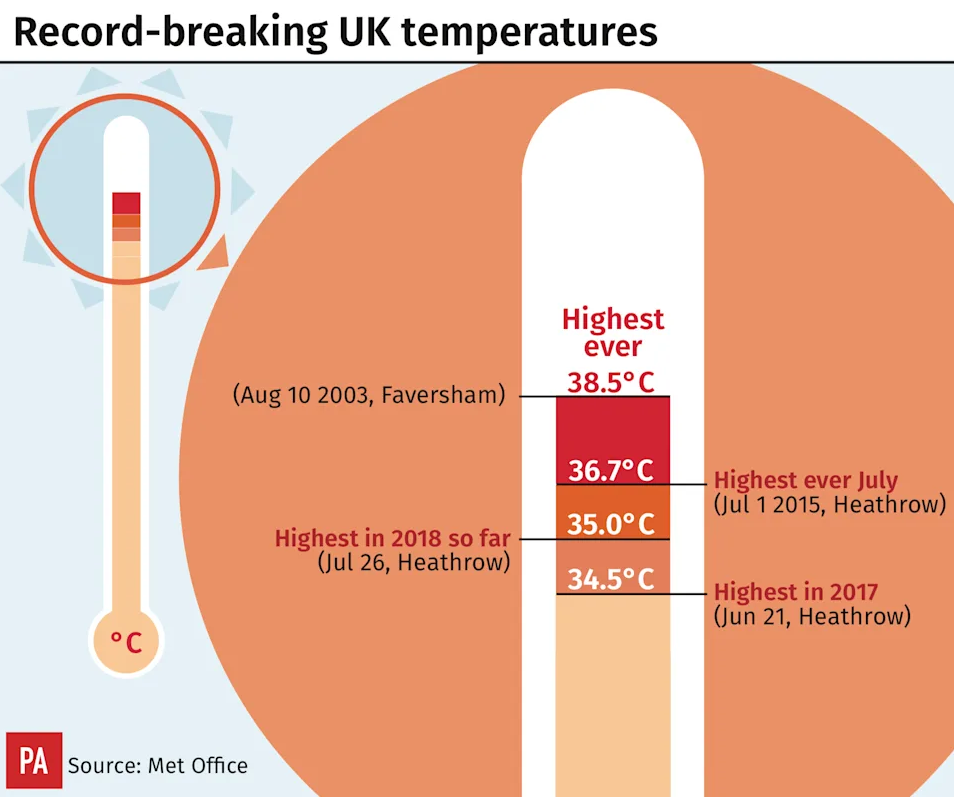
Britain is Overheating — and Our Buildings Are Making It Worse
Something has fundamentally changed about British summers. Not long ago, a week of temperatures above 25°C was a national novelty — a reason to buy ice cream, complain cheerfully, and wait for the rain to return. That era is over. Heatwaves that once arrived once a generation are now a recurring seasonal reality, and the consequences are no longer inconvenient. They are lethal.
In 2024 alone, England recorded 1,311 heat-related deaths. In summer 2025, that toll rose to an estimated 3,039 heat-associated deaths. Climate scientists at Imperial College London have confirmed that human-caused climate change nearly tripled the number of heat deaths during the June 2025 European heatwave, with fossil fuel-driven temperature increases of up to 4°C directly responsible for around 65% of estimated heat fatalities. The Met Office warns that by 2050, heatwaves like those of recent years will occur every other year as a matter of course.
The grim arithmetic of climate change is set in motion. But what happens inside our buildings is, to a very large degree, still within our control — and the solution is not the one most people reach for first.
The Air Conditioning Trap: Cooling That Makes the Problem Worse
When temperatures soar, the instinctive response is to switch on the air conditioning. It is immediate, it is powerful, and it is deeply, structurally wrong.
Air conditioning units work by extracting heat from inside a building and expelling it into the air outside. In doing so, every unit running in a city, street, or commercial district actively raises the outdoor temperature around it, intensifying the very heat island effect it was installed to escape. Urban areas already experience daytime temperatures 1–7°F higher than surrounding countryside, and a proliferation of air conditioning units compounds this warming feedback loop. Cool a room; heat the street. Heat the street; cool the room harder. The cycle drives up energy consumption, carbon emissions, and ambient temperatures simultaneously.
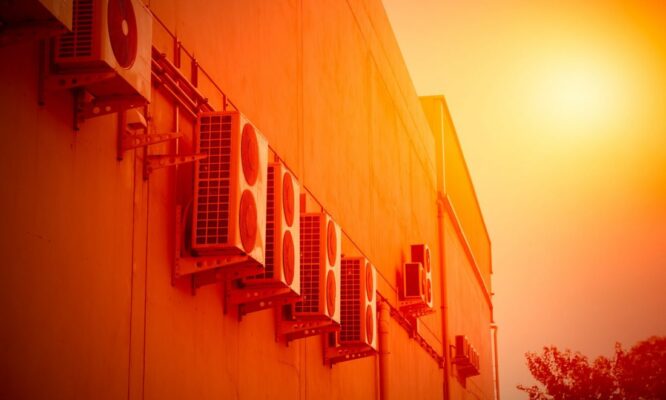
The energy bill consequences are severe, but the environmental cost is arguably greater. Air conditioning currently accounts for approximately 7% of the world’s electricity consumption — close to 20% of all electricity used in buildings globally. In the UK, the buildings sector already contributes significantly to national greenhouse gas emissions, and modelling of London office buildings has projected a five-fold increase in CO2 emissions from city-centre cooling by 2050 if current trajectories continue. The UK’s own net-zero commitments demand a 78% reduction in emissions by 2035 compared to 1990 levels. Running more air conditioning is not a path towards that goal — it is a direct obstacle to it.
There is a better way. A far more effective, dramatically cheaper, and genuinely sustainable way. And it begins not inside the building, but outside it.
The Fundamental Principle: Stop the Heat Before It Reaches the Glass
The critical distinction between external fabric shading and any internal solution — blinds, curtains, films — is one of physics, not preference.
When sunlight passes through a window, it transforms. Short-wave solar radiation transmits freely through glass, and once inside, it is re-radiated as long-wave infrared heat that cannot escape back through the pane. This is the greenhouse effect in miniature, and it happens whether your internal blinds are open or closed — because by the time the sun reaches your internal blind, it has already passed through the glass and deposited its thermal energy into the room.
An external shading system changes this equation entirely. Placed outside the glazing, a quality fabric awning or vertical external blind intercepts and reflects or absorbs solar radiation before it ever reaches the glass surface. External blinds can block up to 97% of incoming solar radiation at source. The small fraction absorbed by darker fabric materials is re-radiated as long-wave infrared heat — a wavelength that cannot pass through glass — and dissipates harmlessly into the air gap between fabric and window. Heat that never enters a building does not need to be mechanically removed.
The British Blind & Shutter Association (BBSA) has demonstrated that properly specified external blinds can reduce internal room temperatures by up to 19.5°C — not just making a room cooler, but eliminating the need for active cooling altogether. When modern double low-emissivity glazing is combined with external blinds, less than 10% of incoming solar heat reaches the interior — a reduction of more than 900% compared to unshaded glazing. External blinds have also been shown to perform four times better than their interior counterparts in direct comparative testing.
External vs. Internal: The Numbers That Cannot Be Ignored
The comparison between external and internal shading is not a matter of marginal gains. It is a performance gulf.
Research cited by the BBSA using their Solar Shading Impact Report compared identical external and internal blinds using a 10% openness screen fabric under the same conditions:
| Shading Type | Heat Transmitted to Room | Solar Heat Blocked |
| No shading | ~100% | 0% |
| Internal blind | ~37% | ~63%[^11] |
| External blind | ~14% | ~86%[^11] |
| External blind (premium spec) | <10% | >90%[9][12] |
Building energy modelling by the National Energy Foundation, using EnergyPlus on a model office, quantified this gap in real operational terms:
| Shading Type | HVAC Energy Saving |
| Internal venetian blind | 10% |
| Internal screen roller blind | 23% |
| External venetian blind | 43% |
| External screen roller blind | 47% |
The message is unambiguous: external shading delivers between two and five times greater energy savings than internal shading, across every building type and configuration. The UK Green Building Council has noted that solar shading can reduce commercial building cooling costs by up to 60%. For existing UK housing stock — of which over 82% reported indoor overheating conditions by 2022, up from just 20% in 2011 — this is not a luxury upgrade. It is a structural necessity.
Why “Fabric First” is the Intelligent Strategy
The concept of a “fabric-first” approach to building thermal performance is well-established in sustainable design. It prioritises passive measures — reducing heat gain and heat loss through the building envelope itself — before reaching for active mechanical systems. External fabric shading is the definitive fabric-first solution for solar control.
A retractable awning over a south-facing window or patio door reduces solar heat gain by up to 65% on south-facing elevations and 77% on west-facing elevations. These are the exact orientations that drive peak cooling loads in summer afternoons and evenings — the times when air conditioning is worked hardest and bills spike. Eliminating that solar input at source means air conditioning either becomes unnecessary or operates at a much higher setpoint temperature, reducing energy draw significantly. The Professional Awning Manufacturers Association energy study estimates potential cooling cost savings of between 15% and 50% through awning installation alone.
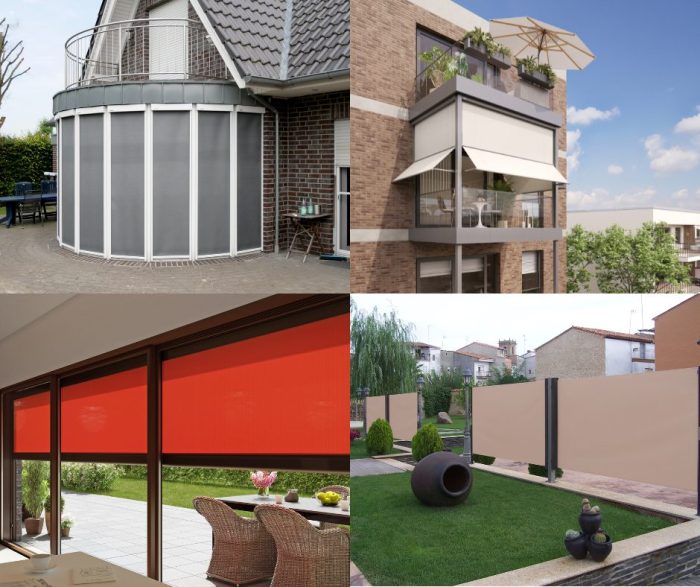
External vertical fabric blinds extend this principle to commercial facades, full-height glazing, doorways, and glazed extensions — precisely the configurations that create the most problematic solar gain. Unlike open window films or anti-reflective coatings, external vertical fabric blinds can be retracted when conditions change, giving occupants precise, dynamic control over thermal comfort throughout the day. On perforated or open-weave fabrics, vision and natural light are maintained even when blinds are fully deployed, preserving the connection to the outside without admitting its heat.
New buildings in England are now subject to Building Regulations Part O, which requires all new residential properties to pass overheating compliance checks. For high-risk locations, external shading is mandated as a primary mitigation strategy — and critically, neither internal blinds nor foliage count towards compliance calculations. The regulatory framework has already recognised what the evidence shows: external shading is the only reliable passive solution.
Pergola Systems and Outdoor Shading: Extending the Protected Zone
The benefits of fabric shading extend beyond the building envelope itself. Unshaded outdoor spaces adjacent to buildings — patios, terraces, hospitality areas, south-facing gardens — absorb and re-radiate solar heat throughout the day, raising the thermal load on adjacent internal spaces and making outdoor living uncomfortable for the majority of daylight hours in summer.
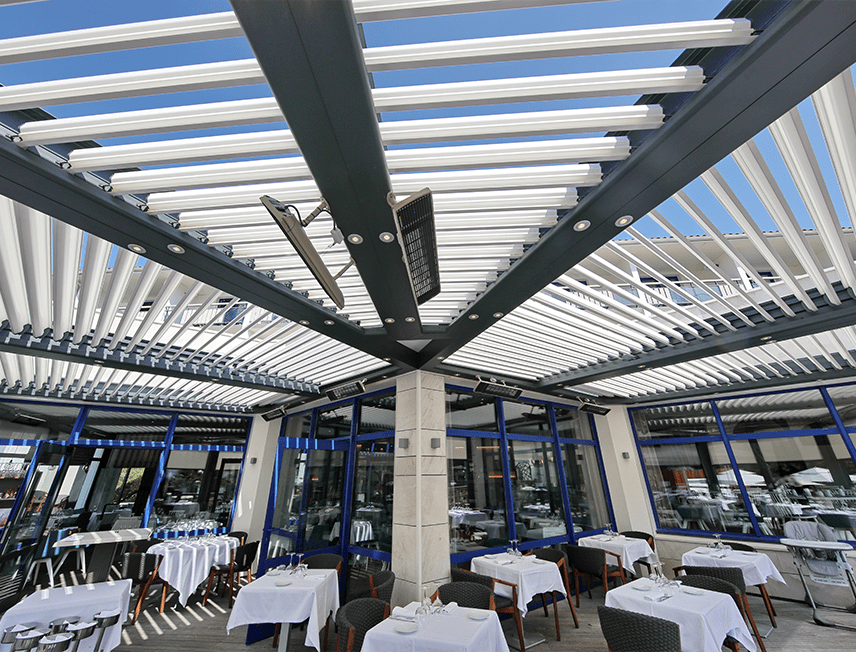
A properly specified pergola system with a fabric or louvred roof addresses this directly. Commercial-grade louvred pergolas can extend the usable season of an outdoor space from approximately 120–150 days per year to 280–320 days — more than doubling commercial operational capacity for hospitality businesses and dramatically improving year-round quality of life for residential properties. The structural frames of quality aluminium pergola systems carry lifespans of 25–30 years, making them long-term property investments rather than short-term weather solutions.
For residential properties, the combination of a retractable awning over doors and principal windows, supplemented by a pergola or canopy over the outdoor living area, creates a comprehensive thermal buffer zone. Solar radiation is intercepted before it reaches glazed surfaces. Outdoor areas remain usable in hot weather. The interior temperature is stabilised by passive means. The air conditioning either stays off, or is run for significantly shorter periods at lower intensity.
The Long-Term Investment Case
Critics of external shading often cite upfront cost as a barrier. The argument is considerably less convincing when placed alongside the real cost of the alternatives.
A domestic air conditioning unit costs between £1,500 and £4,000 to install, consumes significant electricity throughout the cooling season, requires annual servicing, and contributes directly to the urban heat island effect that makes further air conditioning increasingly necessary. It is a solution that perpetuates the problem it purports to solve.
A quality retractable cassette awning, properly specified and professionally installed, costs a fraction of that over its operational life, consumes zero energy in use, reduces cooling loads passively, and protects interior furnishings from UV degradation. High-quality solution-dyed acrylic awning fabrics last 10 to 15 years with normal care, while the powder-coated aluminium frames that support them are engineered to last 20 to 30 years or more. A retractable awning installed today will still be performing on the hottest day of 2040.
External vertical fabric blind systems offer comparable longevity and, when fitted with tracked side-guide systems, provide additional protection from wind and rain that widens their functional season considerably. Commercial installations of façade shading routinely achieve full return on investment through reduced HVAC operating costs within five years.
The UK’s own building energy regulations increasingly reflect this calculus. External shading is recognised under TM59 dynamic thermal modelling as a credible passive mitigation measure. Assessors, architects, and specifiers working on both new builds and refurbishment projects are converging on a clear conclusion: external fabric shading is the most cost-effective, technically superior, and environmentally responsible route to thermal comfort.
The Environmental Argument: No Exhaust, No Emission, No Compromise
It is worth stating plainly what external fabric shading does not do.
It does not burn energy. It does not pump refrigerant. It does not expel heat from one space into another. It does not heat the street outside your building. It does not contribute to the greenhouse gas emissions accelerating the warming that makes shading necessary in the first place.
An awning, a pergola, a vertical fabric blind — these are passive systems operating on the most straightforward physical principle imaginable: block the sun before it becomes a problem. They represent the built environment’s equivalent of sunscreen — applied at the surface, intercepting the radiation, preventing the harm — rather than the equivalent of treating sunburn after the damage is done.
The urgency of the UK’s overheating challenge is not going to ease. The proportion of UK homes overheating surged from 20% to 82% in just over a decade. Climate projections indicate that the number of days exceeding 25°C in the UK could rise from around 10 per year currently to 37 days per year under a 4°C warming scenario. Heat-related deaths — already running at over 3,000 annually in England — are projected to triple to 7,000 per year by the 2050s. More than half of low-income families in the UK live in properties particularly prone to dangerous indoor temperatures.
External shading cannot solve all of this. But it is the single most effective passive intervention available to property owners right now — applicable to any building, at any age, on any budget, without planning permission in most cases.
What Good Specification Looks Like
Not all shading is equal. The effectiveness of external shading depends on correct specification for orientation, building type, and usage pattern.
For domestic properties:
For commercial properties:
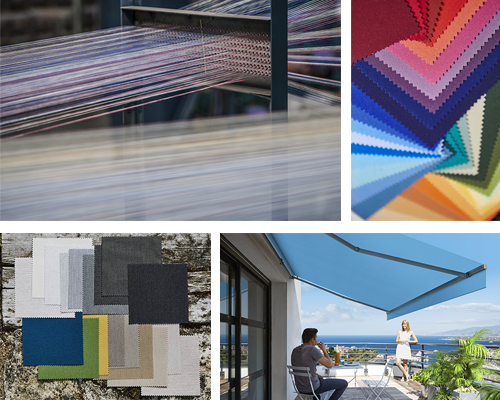
Fabric selection:
The Moment to Act Is Now
The UK is at an inflection point in its relationship with heat. The comfortable assumption that British summers are inherently temperate — that overheating is someone else’s problem, a Mediterranean concern, a future worry — has been comprehensively dismantled by the evidence of recent years. The question is no longer whether the UK will experience dangerous summer heat. It is whether our buildings are equipped to manage it.
Air conditioning is not the answer. It is expensive to run, harmful to the environment, and — because it releases heat into the atmosphere outside — part of the very cycle that drives the overheating it is supposed to address. It treats the symptom while worsening the cause.
External fabric shading — retractable awnings over windows and doors, external vertical fabric blinds on glazed façades, pergola systems over outdoor areas — stops the problem at source. It costs nothing to run. It contributes nothing to emissions. It lasts for decades. And according to the best available scientific evidence, it is between four and ten times more effective at controlling solar heat gain than any interior solution.
Britain’s homes, offices, schools, care homes, and commercial properties deserve better than the false economy of running air conditioning against a summer that is only going to get hotter. The technology to respond intelligently and sustainably already exists — stretched across the exterior of buildings, intercepting the sun before it becomes a crisis.
The only question is whether we choose to use it.
For information on retractable awnings, external vertical fabric blinds, pergola systems, and commercial solar shading solutions, contact a BBSA-registered specialist who can survey your property and recommend a correctly specified external shading solution.
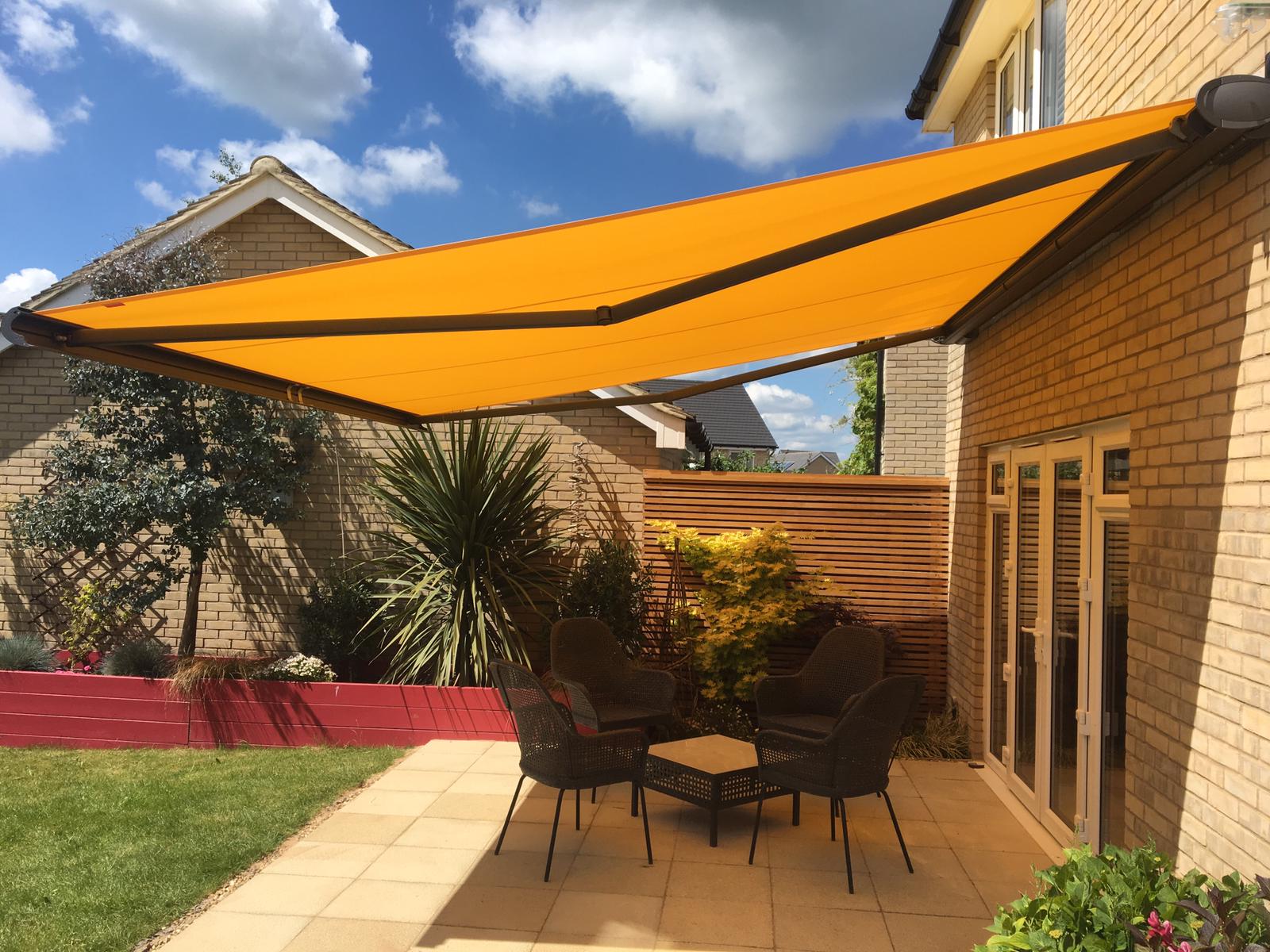
Contact us to arrange a showroom visit, or send an image and measurements for a tailored quotation, all backed by our decades of expertise and commitment to quality.
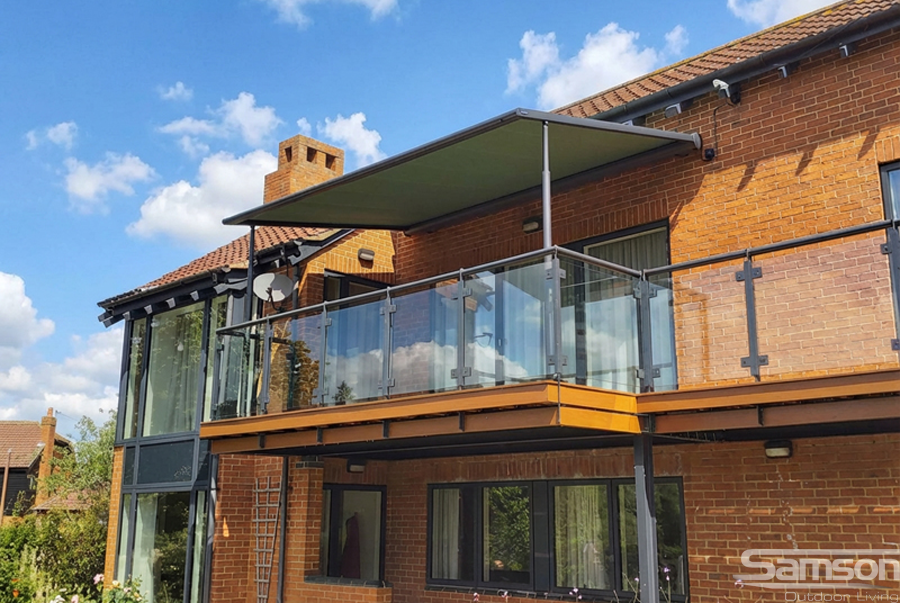
Awnings for Balconies
UK balconies are being asked to do more than ever. Many homeowners are searching for a cleverer way to utilise their balconies without getting scorched or packing everything away at the first drop of rain.
At Samson Awnings, we are seeing a noticeable change: balcony shading isn’t simply for occasional bright days. The goal is to design a useful, adaptable outdoor area that you can truly depend on throughout the spring, summer, and autumn. In this article, our team will show you some options to elevate your balcony shading and help you find out which one is for you.
The case for better shade
Well-designed external shading helps cut glare and reduces the amount of heat that reaches your doors and glazing. The result is a balcony that feels noticeably calmer on bright days – and a room behind it that is often easier to keep comfortable. But in the UK, the real test is rain. That is where the difference between a folding arm awning and a retractable pergola becomes most obvious.
Folding arm awnings (open feel, instant shade)
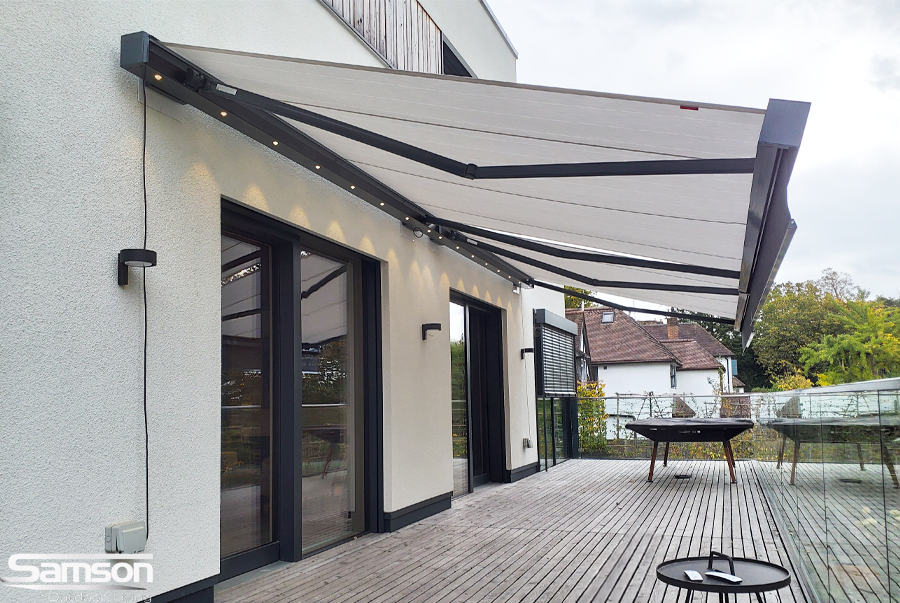
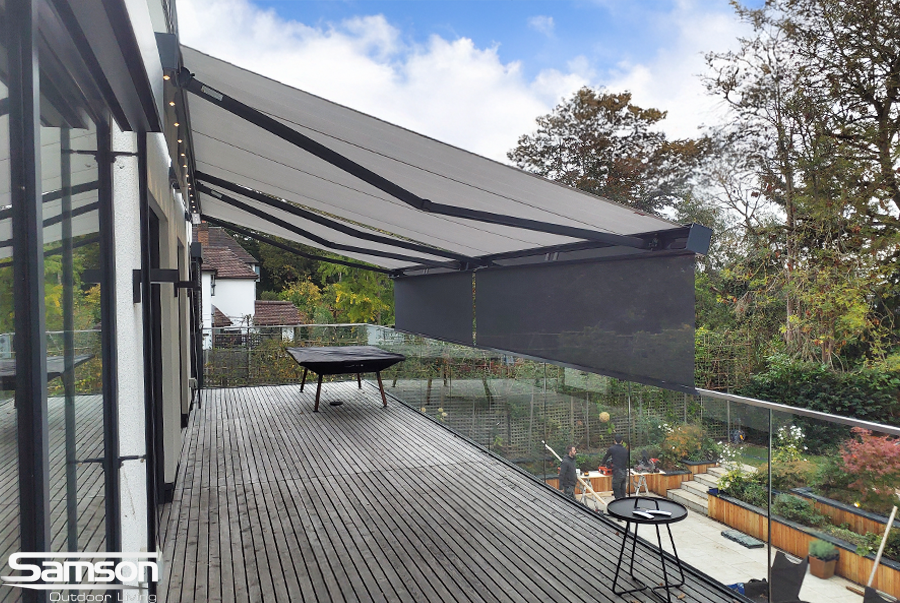
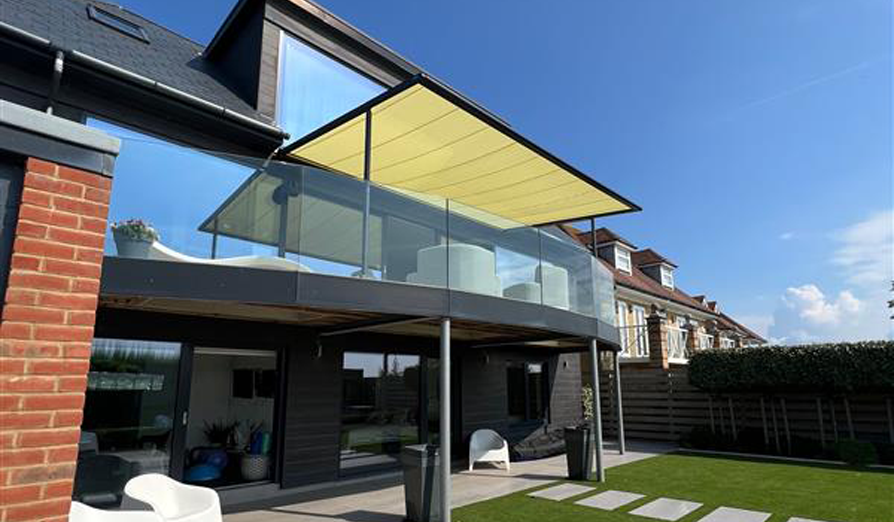
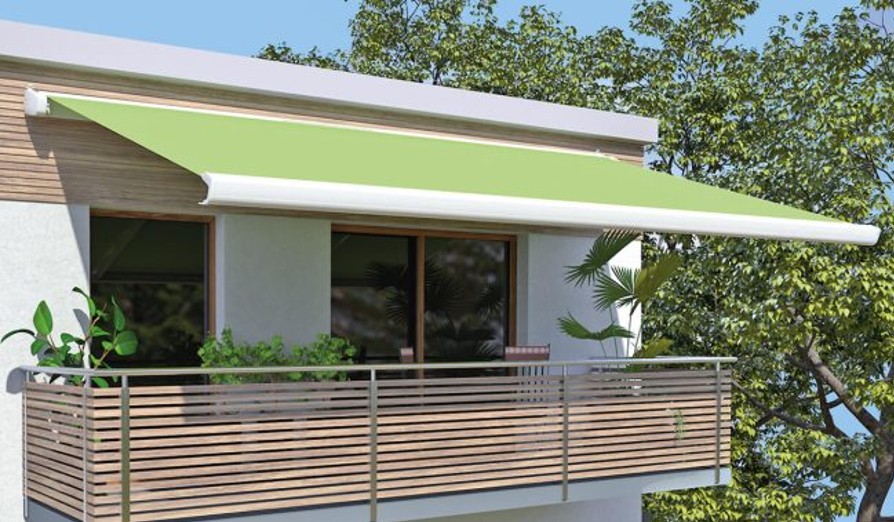
A folding arm awning is all about flexibility. Extend it when the sun is strong, then retract it back into its cassette when you want a fully open balcony again. It is a great fit for compact balconies because it keeps the floor area clear – no front posts, no obstruction.
Most quality awning fabrics will cope well with a passing shower, provided the awning is set to the right pitch so water can run off cleanly. For changeable days and everyday shading, it is hard to beat.
Retractable pergola (Ready for tougher conditions)
A retractable pergola is a step up in structure. The roof fabric runs within side guides and is supported by front posts, which allows the material to stay far more tensioned than a standard awning in all directions.
That tighter, guided fabric roof is what improves performance in prolonged rain and breezier conditions – particularly on higher or more exposed balconies. Many systems also incorporate water management (such as integrated drainage), helping keep the area beneath more consistently usable.
Folding arm awning vs retractable pergola: Which one is for you?
The answer depends on your preference. These are some factors that you might need to consider before making decisions.
| Feature | Folding arm awning | Retractable pergola |
| Best for | Everyday shade and an open balcony feel | Creating a more sheltered “outdoor room” |
| Rain protection | Handles light showers well with correct pitch | Better suited to longer, heavier spells |
| Wind resistance | More weather-sensitive; sensors help protect the system | Typically more stable in exposed locations |
| Space | No posts; ideal for narrow balconies | Posts/structure need space and solid fixing points |
| Visual look | Discreet when retracted | A more architectural, defined feature |
CONCLUSION
If you want shade on demand and you value keeping the balcony as open as possible, a folding arm awning is often the most elegant solution. If you want a balcony, you can furnish and use more consistently – despite the forecast – a retractable pergola is usually the stronger option. Speak with our team to explore how we can help you transform your balconies this season.
Contact us to arrange a showroom visit, or send an image and measurements for a tailored quotation, all backed by our decades of expertise and commitment to quality.
External shading for UK doors and windows is most effective when high‑quality products are professionally specified and installed. At Samson Awnings, we specialise in exactly this type of made‑to‑measure shading and weather protection.
By combining technical external blinds, awnings, and shutters with expert surveys and installation, Samson helps homeowners and commercial clients solve overheating, glare, and privacy problems on almost any type of glazing.
If you are struggling with solar gain or looking to improve the energy efficiency of your property, here is why external shading is the solution you need – and how Samson Awnings can help.
Why Expert Installation Matters
Samson Awnings has built a strong reputation across the UK for supplying and installing premium awnings, external blinds, and associated structures for both domestic and commercial projects. From our Northamptonshire base and dedicated commercial division, we regularly work on homes, pubs, restaurants, schools, offices, and healthcare buildings that need better control of sun, heat, and weather.
As a specialist, Samson does more than simply sell products in a box. We know that every building is different. Every project starts with understanding how you use the space, the orientation of your glazing (South and West facing glass is often the biggest culprit), and the level of privacy or weather protection you require.
That expertise is crucial. Choosing between vertical fabric blinds, retractable awnings, drop‑arm systems, or aluminium shutters can be confusing, but our team ensures the final specification genuinely improves your comfort and usability.
1. Vertical Fabric Blinds: Precise Control for Modern Glazing
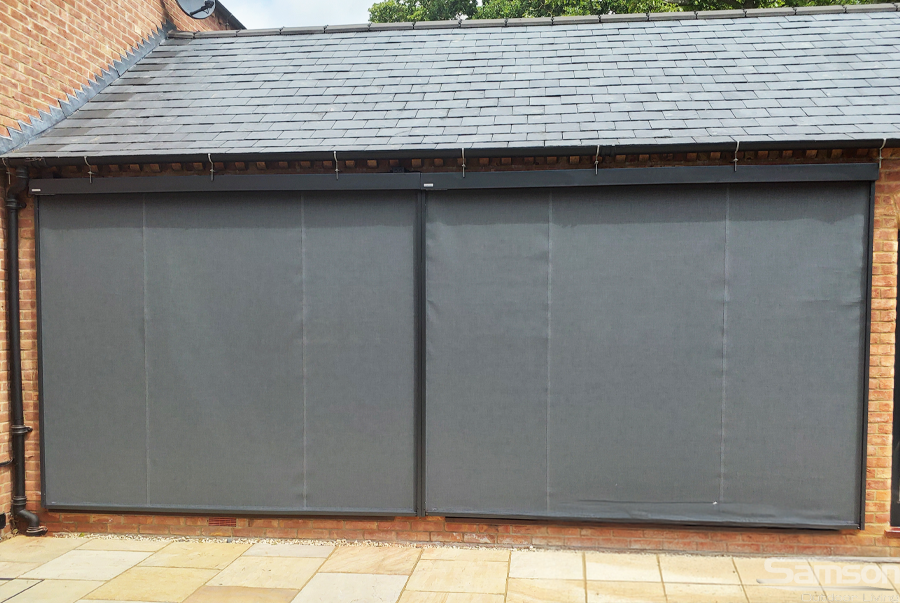
For large windows, patio doors, and glazed façades, external zip or wire‑guided fabric blinds are widely considered the most advanced solution for controlling solar gain.
Samson supplies and installs external vertical blinds featuring side channels or cable guidance. These systems keep the fabric taut and stable even in breezy conditions, providing a neat, modern finish that suits both contemporary homes and commercial elevations.
The Key Benefit:
We offer a huge selection of fabrics, including technical perforated meshes. These intelligent fabrics allow you to retain your view of the garden and benefit from natural ventilation while blocking the majority of direct sunlight, UV rays, and prying eyes.
Fitted externally, these blinds allow you to keep your windows open behind the fabric during warmer months. This keeps rooms cooler by circulating air while protecting your interiors from driving rain and harsh sun. For clients needing serious performance on South and West‑facing glazing, this is often our top recommendation.
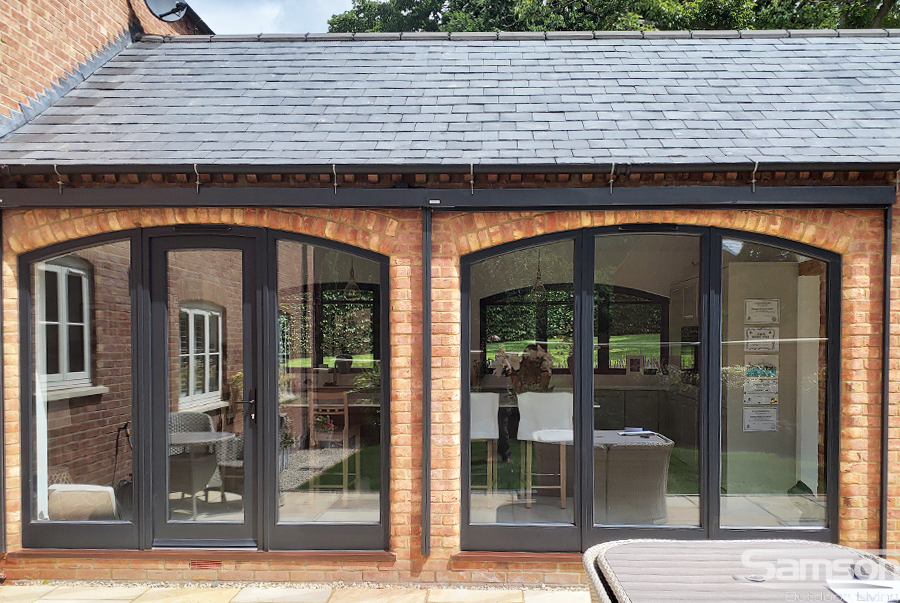
2. Retractable Awnings: Shading Glass & Creating Space
Retractable awnings remain a core part of the Samson Awnings range. They are a dual-purpose solution: they shade the glass to keep your interior cool, and they create a fantastic covered area immediately outside.
Our made‑to‑measure cassette awnings can span large widths over bi‑fold doors, patios, or commercial terraces. Crucially, they come with adjustable pitch settings. This allows the awning to be angled to counter low-lying evening sun (common in the UK autumn) as well as higher midday sun.
Built for the UK Climate:
Samson works with leading European manufacturers to offer robust, wind‑tested systems suitable for British weather. They can be specified with manual or motorised operation, wind sensors to auto-retract during storms, and even integrated lighting and heating.
For homes, this means cooler indoor spaces and a defined outdoor “room” for dining and relaxing. For businesses such as cafés and pubs, it creates usable, revenue‑generating covered space throughout the year.
3. Drop‑Arm Awnings: Focused Shading
Where focused shading is needed on specific, individual windows, drop‑arm awnings offer a simple, proven, and stylish solution.
The compact cassette and projecting arms make these systems ideal for upper‑storey windows or façades where heavy structural fixings aren’t possible. Some models can pivot almost 180 degrees, allowing the fabric to drop vertically like a standard blind when required, offering excellent privacy and low-sun protection.
Samson’s experience with domestic and commercial installations means these awnings can be integrated sensitively onto period properties as well as modern buildings. If you have a bedroom or home office that overheats, a drop‑arm awning is often a cost‑effective, unobtrusive fix.
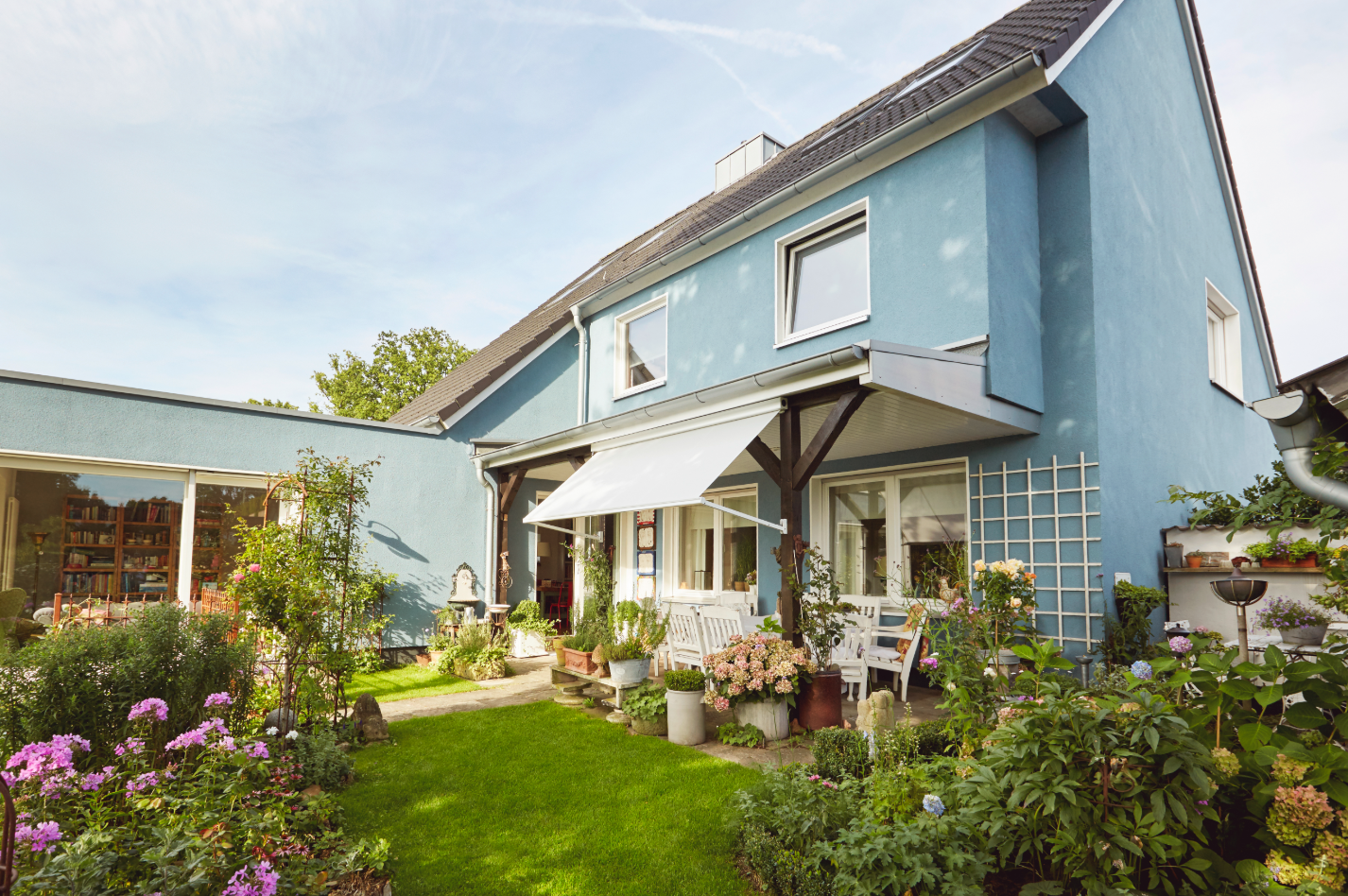
Seamless Integration:
Samson’s installation teams ensure shutters operate smoothly, with options for manual or electric controls. They become a practical everyday tool for controlling your environment rather than just a security barrier used at night.
Start Your Project with Samson Awnings
Whether you are dealing with a hot south‑facing kitchen, an office full of screen glare, or a fully glazed commercial frontage that overheats, we can recommend the right solution.
If you are looking for a shade solution, contact us today to explore how professional external shading can transform their building.
Contact us to arrange a showroom visit, or send an image and measurements for a tailored quotation, all backed by our decades of expertise and commitment to quality.
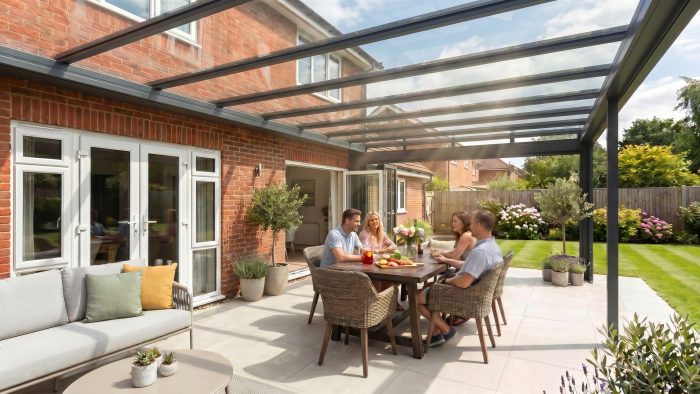
If you are planning to enhance your outdoor living space with a glass verandas, there are some factors which can decide the prices. From sun, rain, to high winds, the British climate sets high demands on outdoor structures, making careful selection of your veranda’s specification not just wise, but necessary.
A glass veranda is a top choice for sure for all year round use and will provide excellent rain protection as well as sun shade when specified with a retractable fabric blind, but do be aware of the differences in quality and performance in the longer term.
What Drives Price Differences in Glass Verandas?
Several main factors play a significant role in determining the price of a glass veranda can be listed:
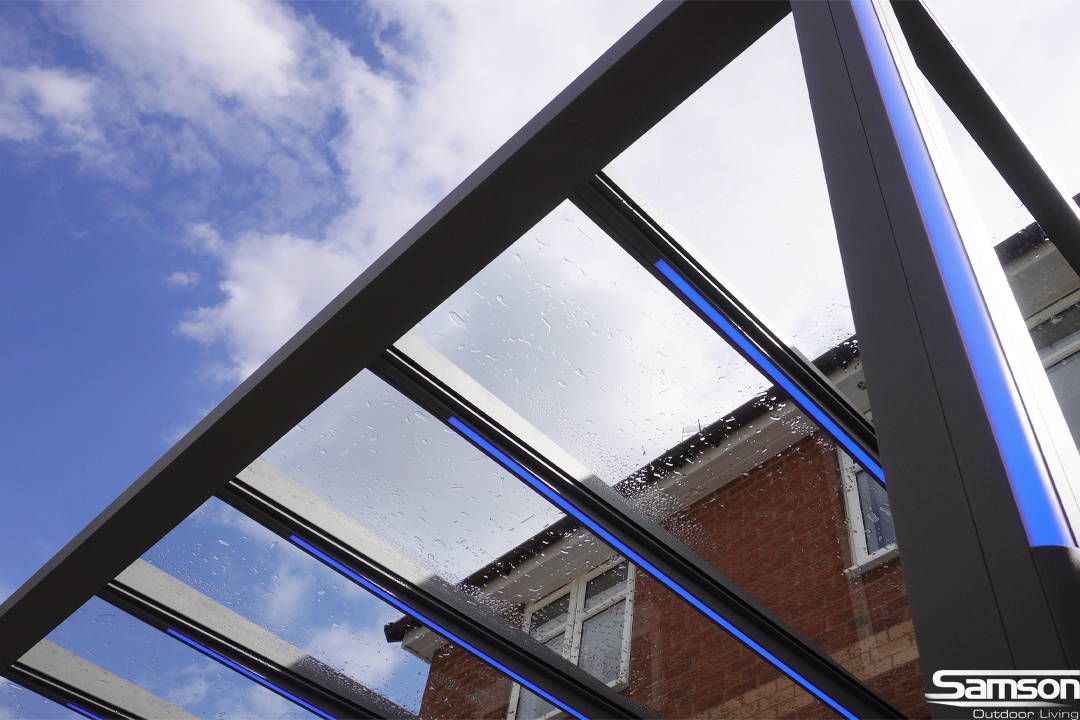
1.Size and Design Complexity:
Larger verandas mean more glass, frame, and engineering—costs rise accordingly. Designs that include curves, elaborate supports, or full glass walls at the sides will incur further expense compared to straightforward, open-roof models.
Many excellent flat roof models are now available but can be more costly than basic lean to models, for the right reasons.
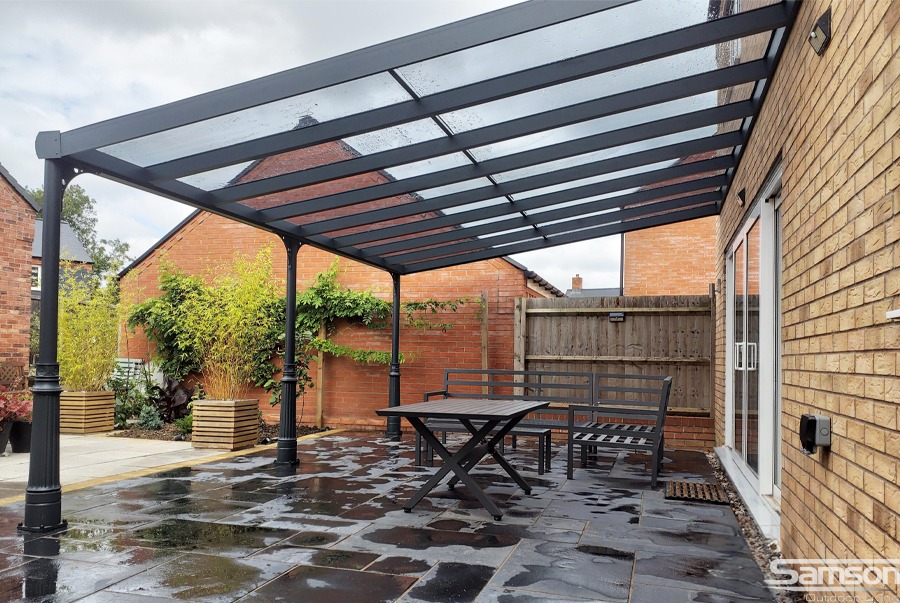
2.Glass Quality and Type:
The glass choice is important for both price and quality. High quality glass as thick laminated safety glass (usually 8.8mm to 10.8mm) offer better impact resistance than thinner or standard glass. Some other features such as tinting, self cleaning coating or UV protection also increase comfort and performance, as well as total price.
3.Frame Material and Construction: Superior powder coated aluminium, the foundation of any verandas, guarantees longevity and durability, even in coastal regions where corrosion could be a concern. Timber and steel designs may attract different costs and require more maintenance, but aluminium is always the best. Precision manufacturing and robust fixings are essential to outlast strong winds and driving rain. High quality paint finish always seems to be a strong factor we encounter with cheaper painted veranda profiles tending to fade very quickly indeed when positioned in the full sun and a south facing position.
4.Enclosure: Simple open-sided verandas (just a glass roof) are more affordable. If you want to enjoy year-round protection and comfort, enclosed glass rooms, multiple sliding doors, and advanced drainage or heating features all increase the budget needed.
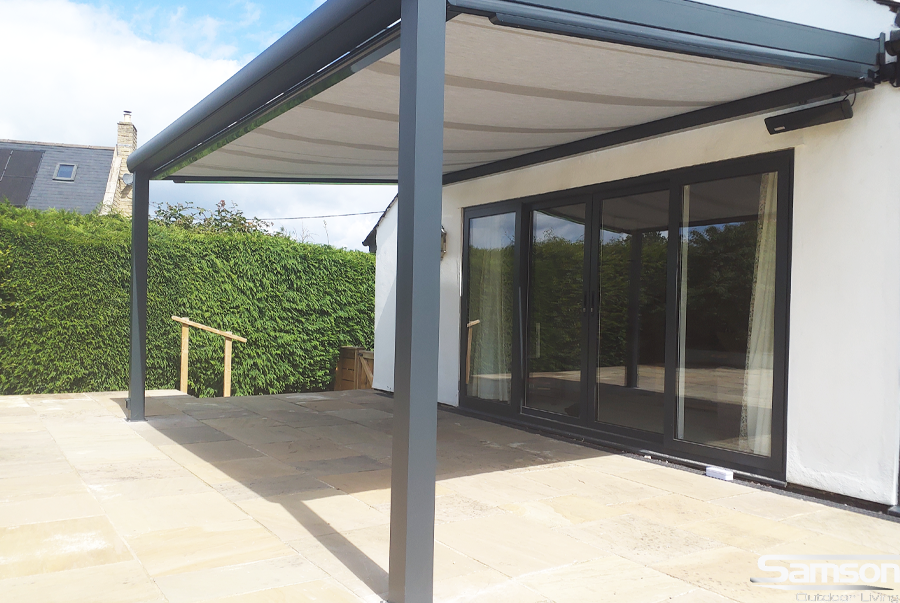
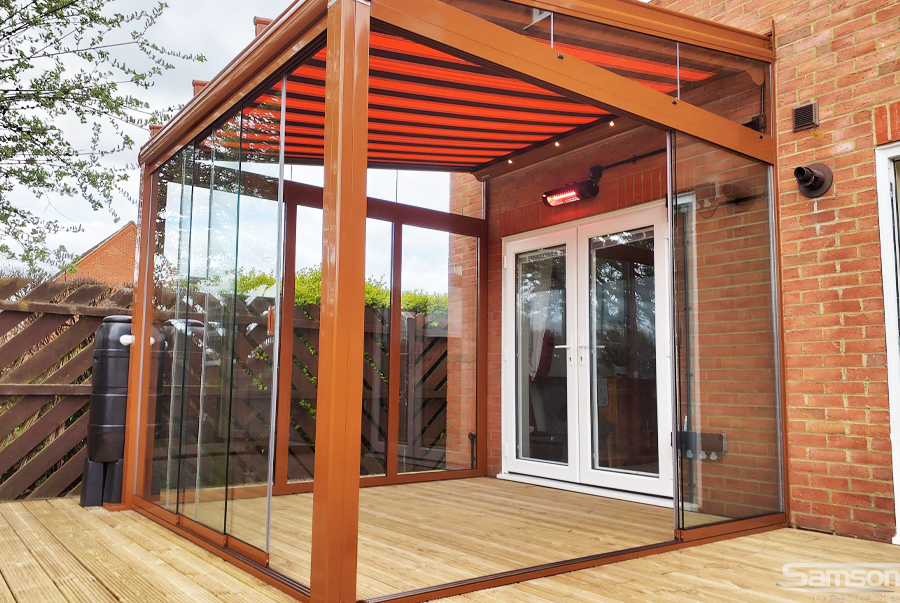
5.Installation and Location: Professional, experienced fitting guarantees the integrity and safety of your veranda, but can affect cost depending on site access and local labour rates. Extensive groundwork or preprepared concrete bases obviously affect the time on site for construction.
Why Budget Models Deserve Caution in the British Climate
It can be tempting to select a glass veranda based simply on a headline price, but beware – budget systems may simply not be fit for purpose in the UK. Cheaper verandas often use thinner glass and lightweight support structures. They might work in milder mediterranean climates, however, UK weather is famous for strong wind gusts, heavy rains and storms. Therefore, poor quality glass and frames run the risk of bowing, cracking or failing completely and leading to costly repairs or replacement.
Investing in a high-quality system – engineered specifically for the UK, or mainly Northern European climate means superior durability, safety, and peace of mind.
At Samson Awnings, our bespoke glass verandas are meticulously specified using robust, weather tested components suitable for the harshest British conditions with certified performance.
Final Guidance for UK Buyers
A glass veranda is a long-term investment in your outdoor enjoyment and property value. With Samson Awnings, you can be confident your solution is designed to stand up to the unique demands of British outdoor living.
See our Price Examples page for Glass Verandas for further information:
Contact us to arrange a showroom visit, or send an image and measurements for a tailored quotation, all backed by our decades of expertise and commitment to quality.
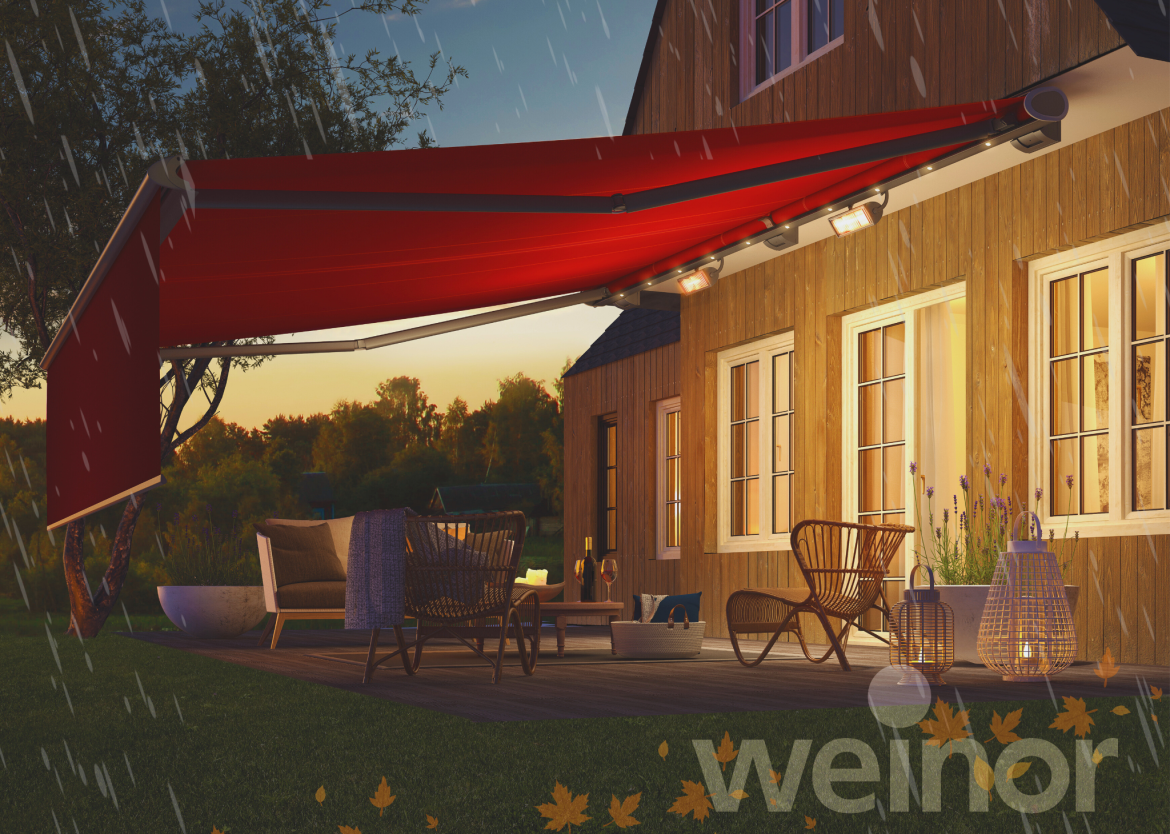
Creating an outdoor covered space which is truly protected from the elements all year round is quite hard to achieve in the UK. The simple fact is that any outdoor space designed mainly for use in the spring, summer and autumn months, will probably not be the most inviting in the depths of winter. It isn’t meant to be in most cases, the idea generally is to extend the amount of time you can be outdoors by around 4 months in an average year, but also to specifically not worry about sudden rain showers or the wind whipping up in the afternoon.
In this article, the Samson team will explore some of the best options available to keep your outdoor space usable come rain or shine all year round.
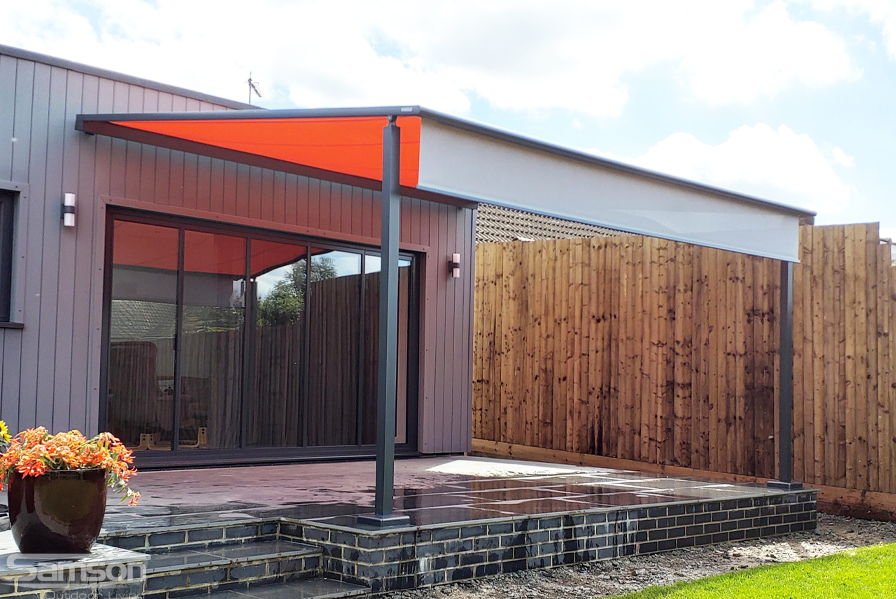
Light Rainfall and Breezes.
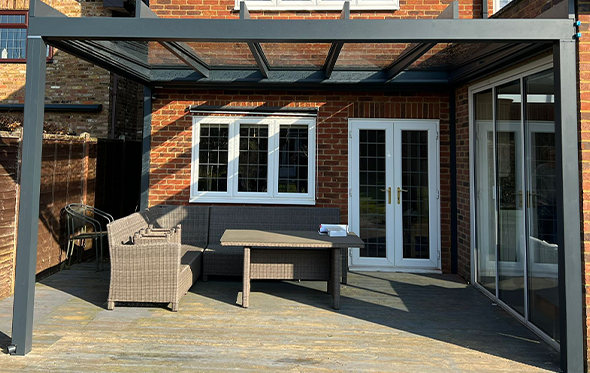
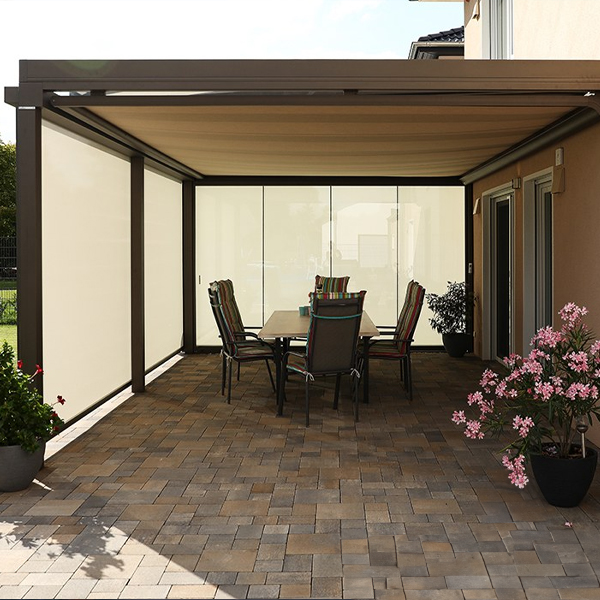
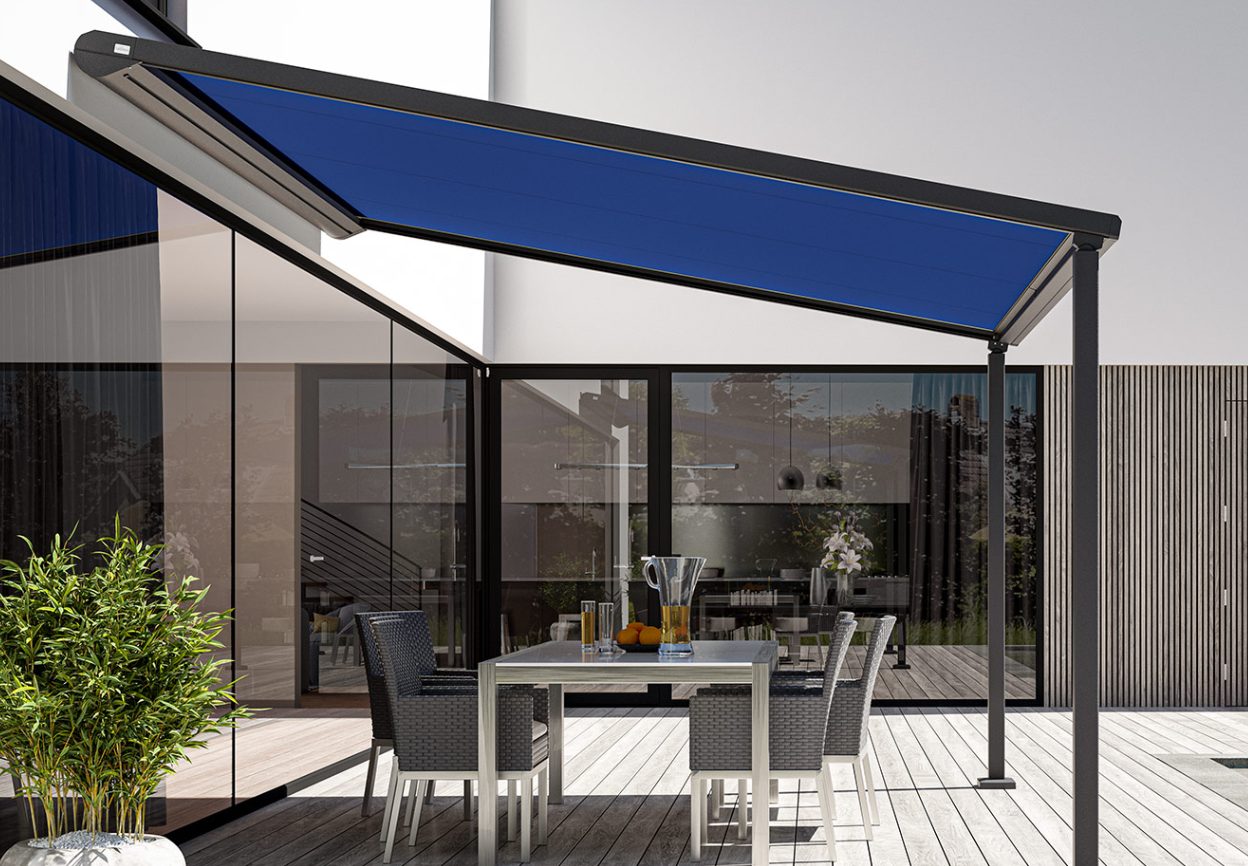
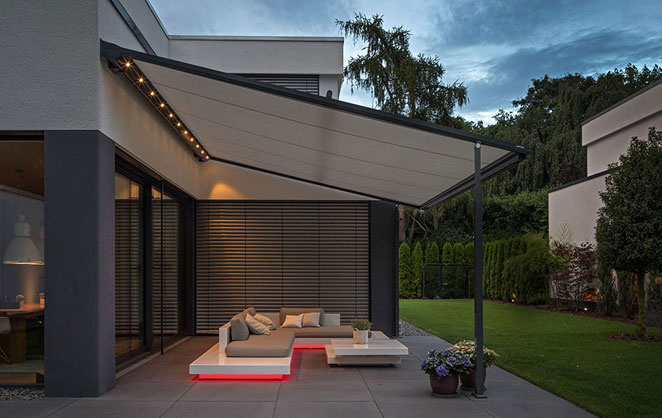
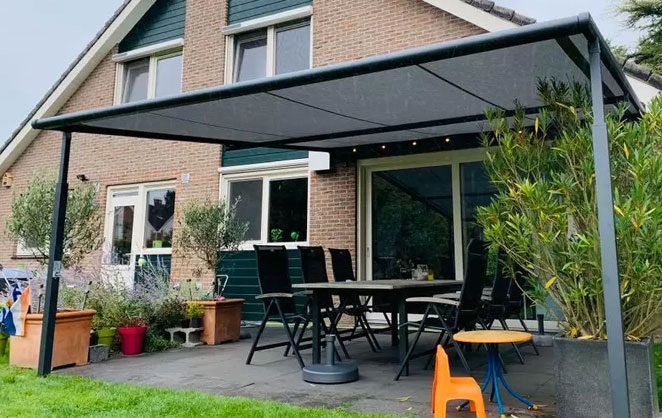
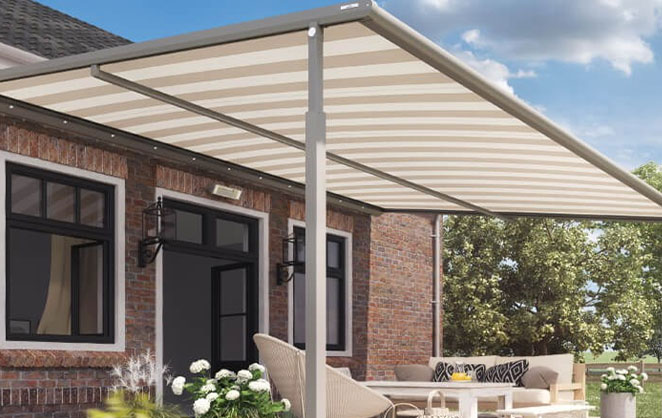
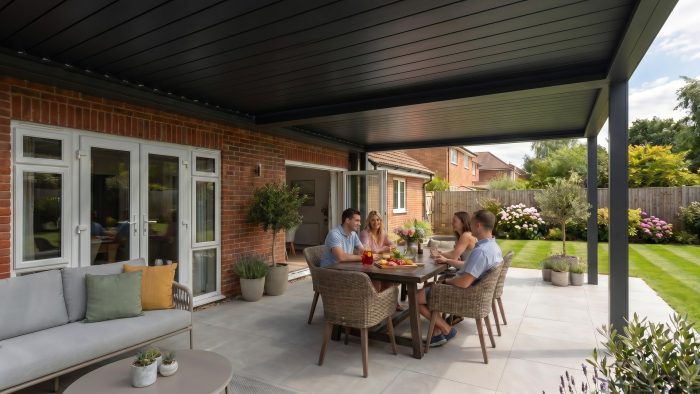
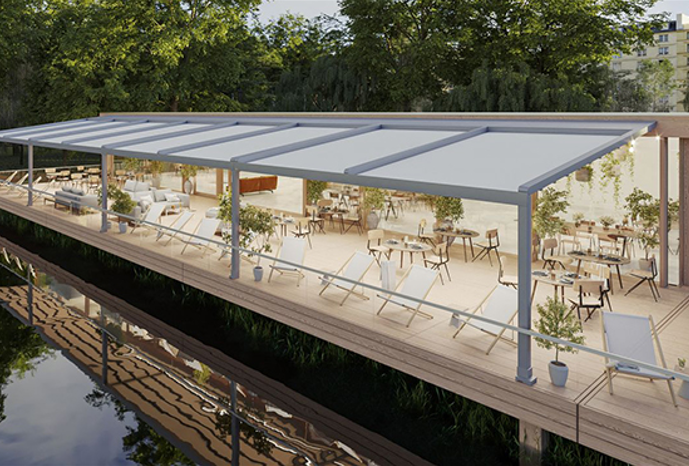
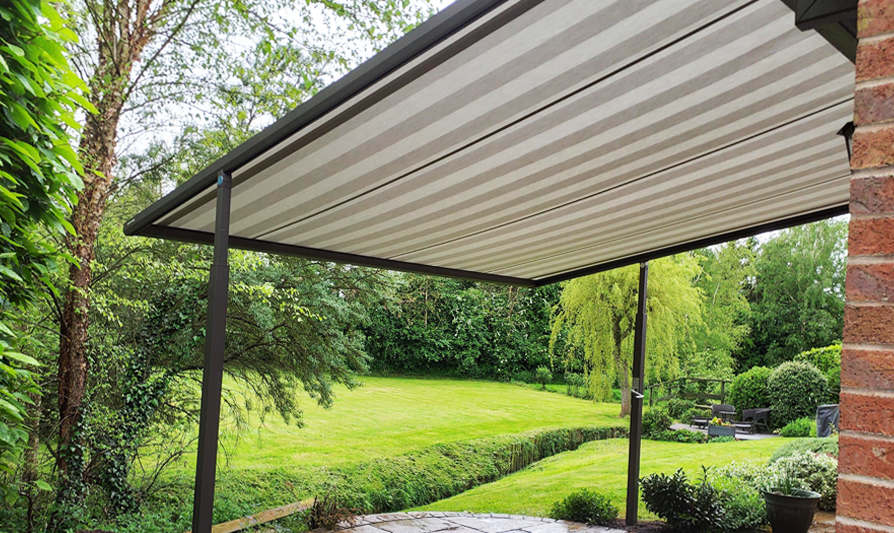
To create a covered area with protection from rain and a light cooling breeze and as a retractable solution we look towards the Retractable Fabric Pergola.
Introduced in around 2010 to the UK, the simple principle of a retracting fabric cover on a light aluminium framework which extends and retracts as required, but can also have a drop down front fabric valance for light breezes and retractable side awnings on one or both sides.
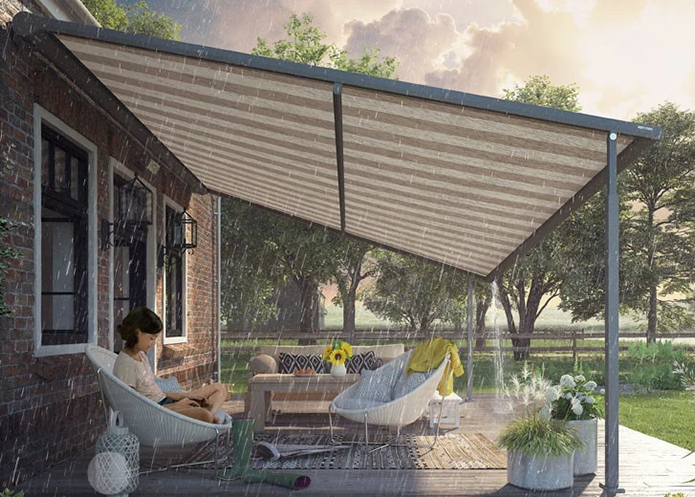
Create your own lovely covered space which is always light and airy as natural light flows through the lighter coloured fabrics. The simple push of a button and the roof retracts out of sight and into a neat cassette on the wall. The fabric is at an angle for the rain to flow off to the front and this angle is adjustable if required with optional telescopic posts at the front. The retractable pergola is the best solution when you know you want to use the outdoor area in the rain, but also want open to see the sky whenever possible too.
Medium Rainfall and Wind
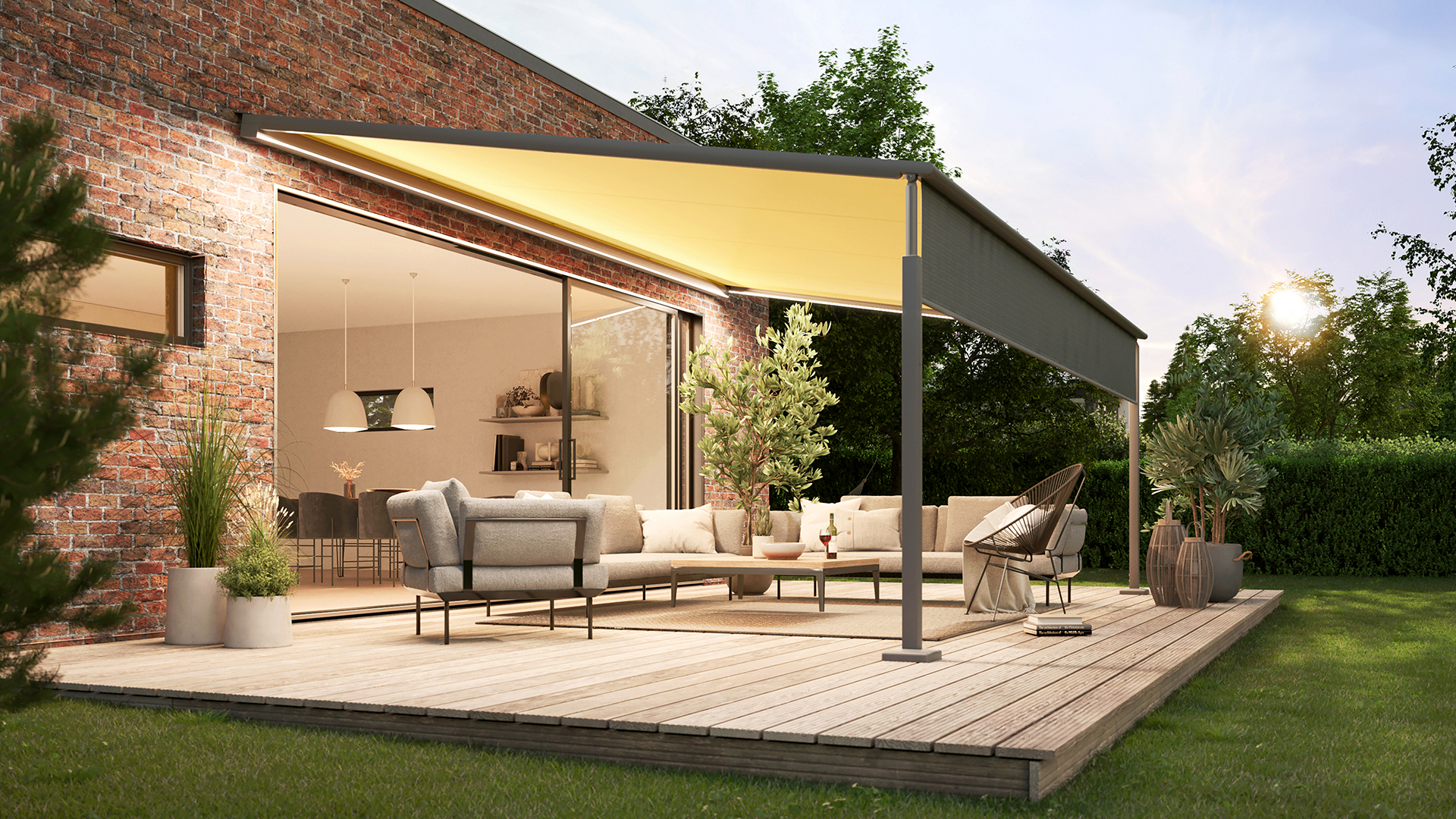
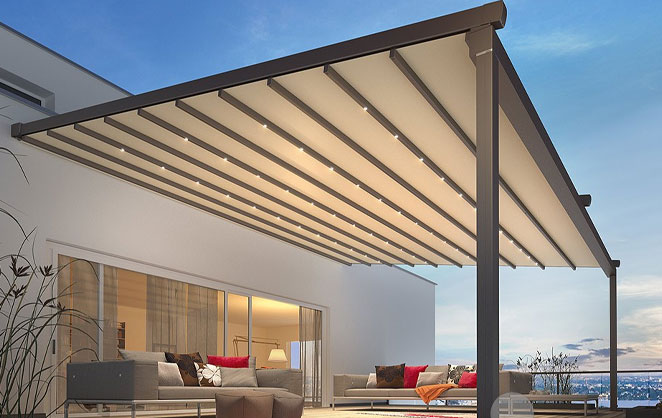
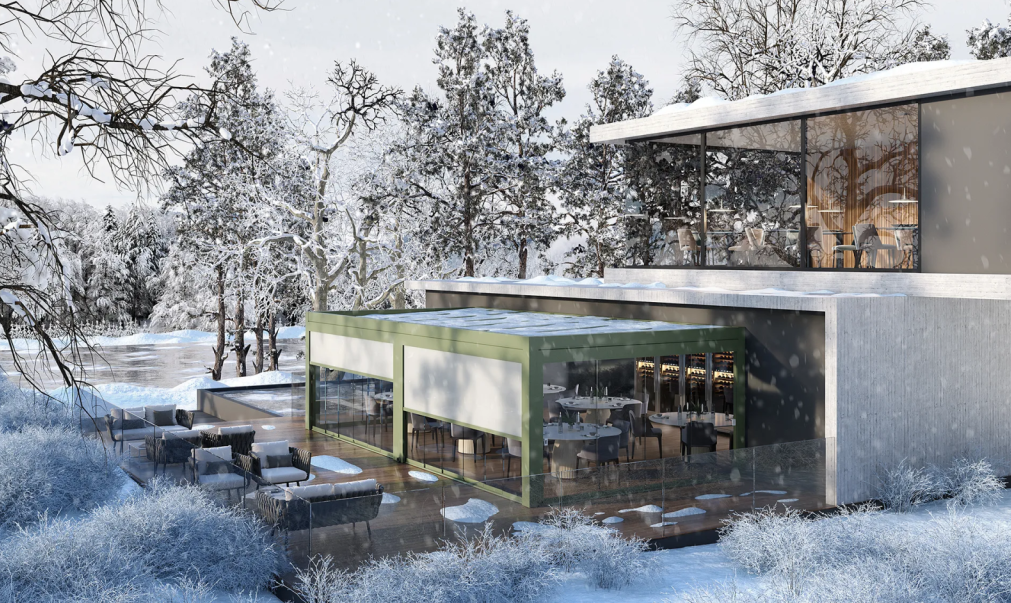
The same principle applies here with a retractable electric pergola fabric roof system, but the lourved roof system is triple layered and 100% waterproof and very strong. The framework in which the fabric works within is also larger and incorporates rainwater guttering into the front profile.
Available as either a wall mounted system or as a freestanding pergola system this type of retractable roof is very popular in multiple applications because of the flexibility with the climate control. Full air flow when the sides are all opened up and a total barrier to wind and rain when closed. These systems can be a lean to design or flat roof design to suit the building or application and can also be connected to each other to create very large covered spaces when required, making them perfect for commercial settings too.
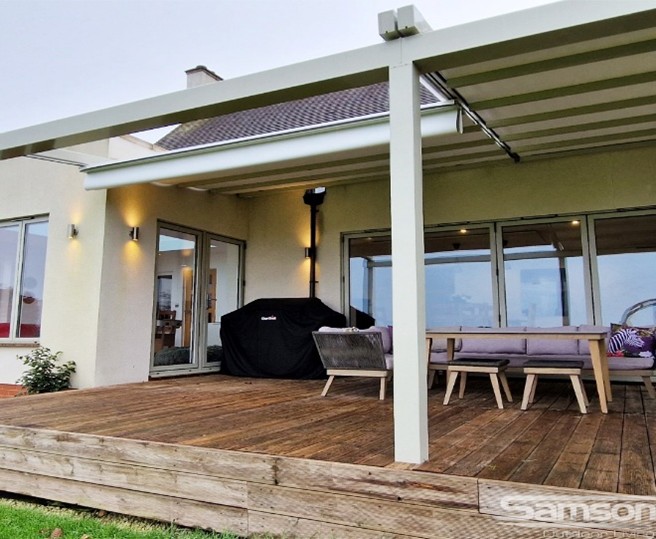
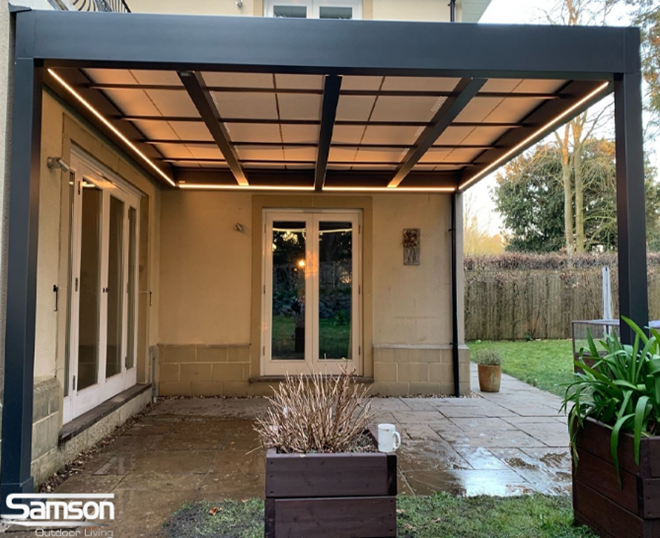
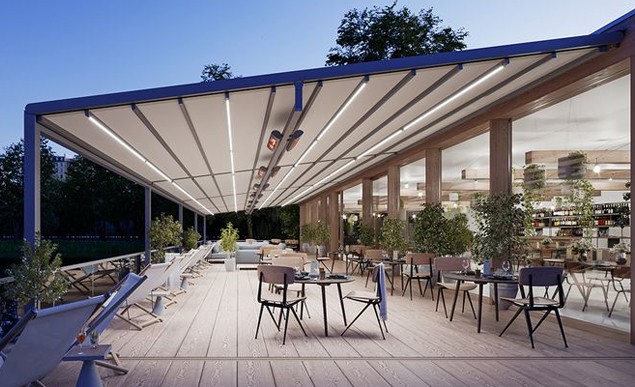
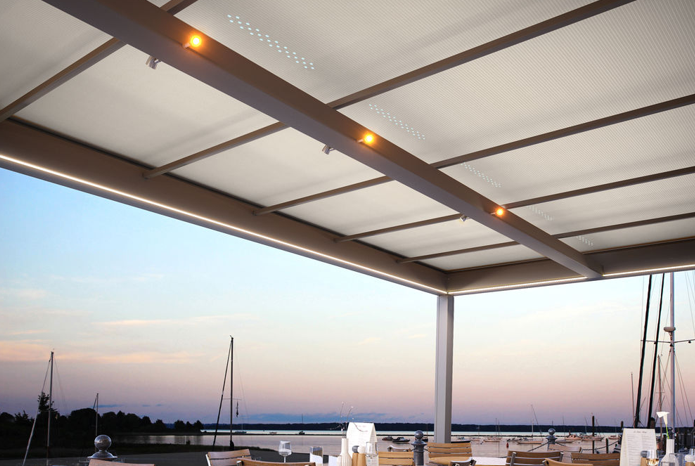
With these structures you can easily add exceptionally high quality LED lighting and various forms of infrared heating to maintain use into the evenings and winter months.
Heavy Rainfall and Wind
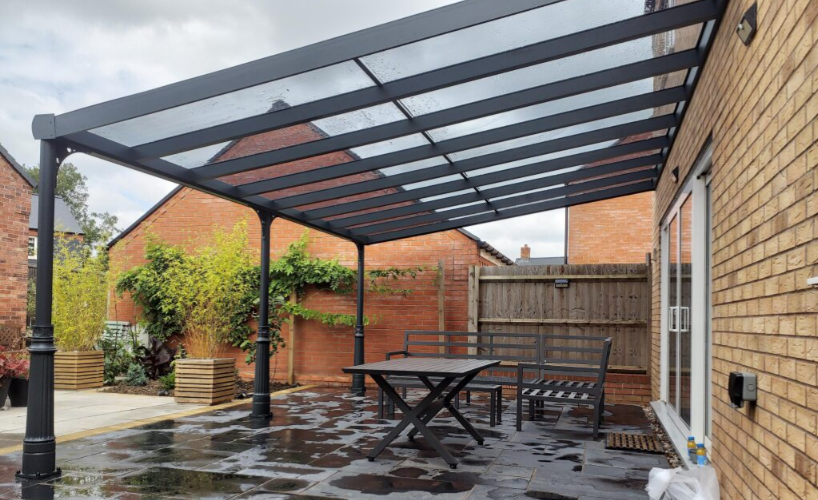
Once you have a combination of heavy rain and heavy wind then being outside perhaps isn’t the best experience but there are products which can deal with the rain and wind and are normally designed around the use of solid glass, a 100% waterproof material with maximum natural light transmission.
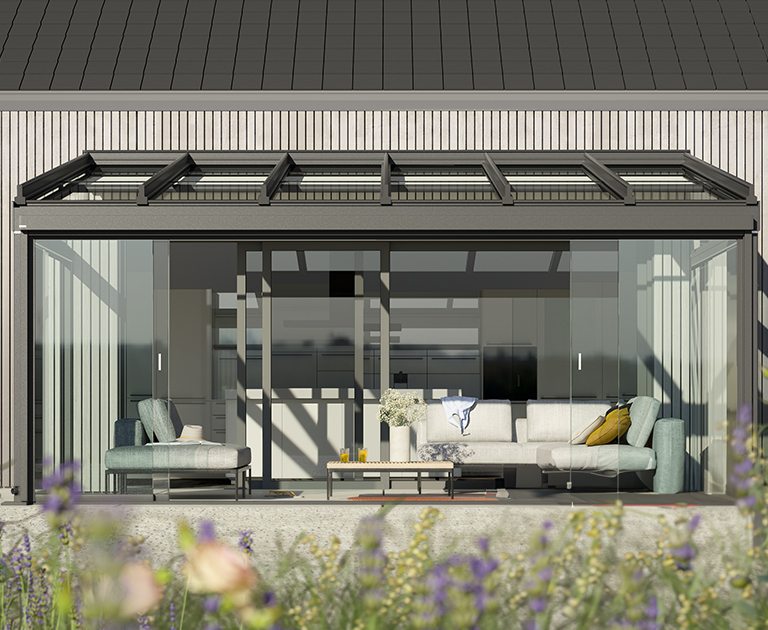
Our wide range of glass structures give you total protection from rain above and depending on the side infills specified will also protect you from strong winds too.
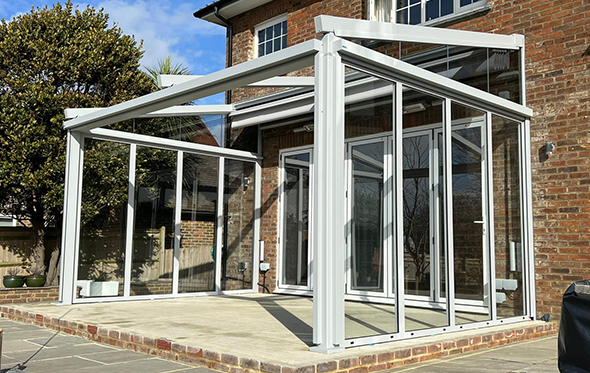
Either referred to as ‘glass verandas’ with open sides, or ‘glass outdoor rooms’ when the sides are enclosed with various options.
Wind Protection Products – Retrofit Options
When an outside area is exposed to wind the cooling effects can be prolific and it isn’t pleasant at any time trying to relax, drink or eat in windy conditions. There are some great solutions for domestic and commercial sites, depending on the site conditions and available fixings.
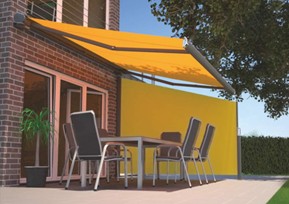
Retractable Side Blinds – A manual fabric blind which pulls out from a cassette fixed on the wall or strong post to clip into another post or bracket when extended. Available in various widths and heights and over 200 fabric selections this is a great way to prevent annoying breezes in any patio or garden area
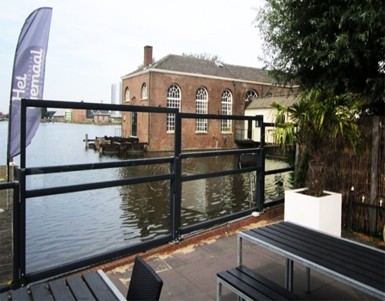
Rising Glass Barriers– A manual or electric operated rising glass wind break to offer a barrier but also clear vision too. A fixed glass section protects to one height and is fitted in various fixed or movable systems and a second glass section can rise to double the height of the protection when required.
Available as a bracket to ground fixed system or in various weighted box formats which can be relocated easily when required and also used as planters with a steel box attachment.
Fabric Cafe Barriers – Fixed or free standing with weighted bases, fabric barriers provide a wind break and create a defined area for outdoor seating and other purposes. Variable sizes for the width and height and with or without printed graphics as required.
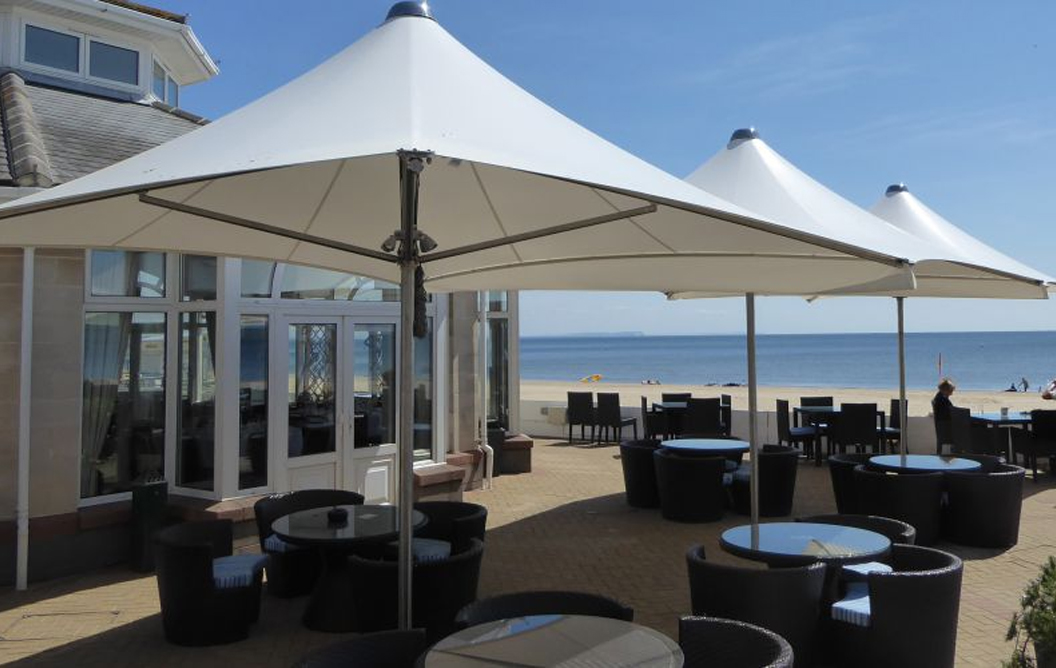
Need help deciding on the right umbrella for your needs or require more information?
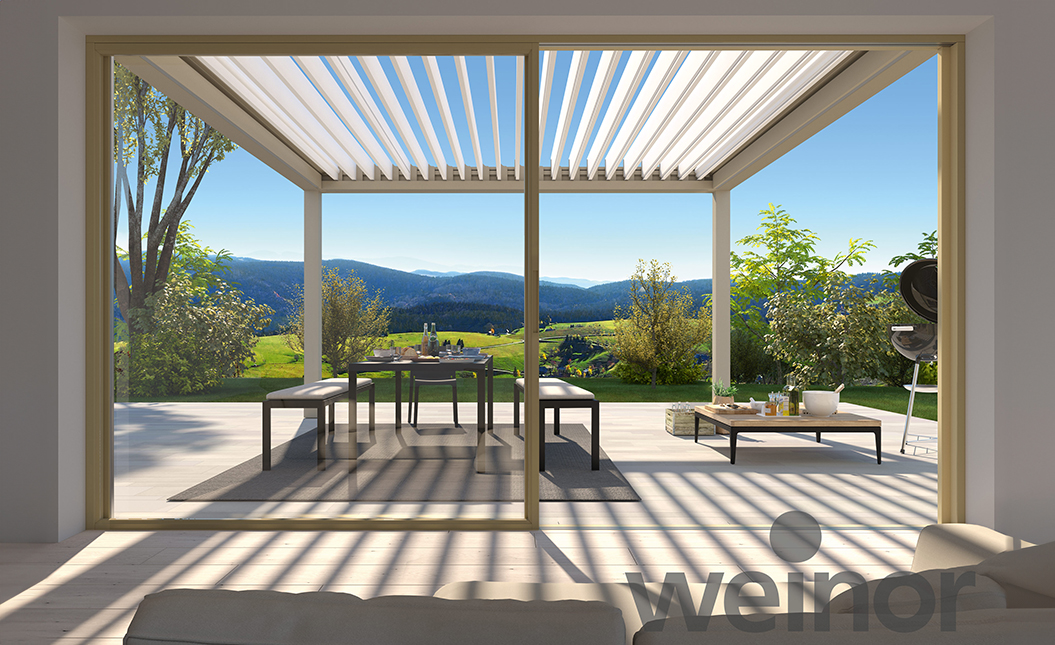
Summer is the perfect time to enjoy the great outdoors, but the unpredictable British weather all too often interrupts it. Whilst a lot of products we supply and install are for sun shading and protection from harmful UV rays and the intense heat, we are in the UK and it still rains a lot anytime of the year and often without warning.
So, which products are best to consider, specifically if you want to protect yourself, your friends and family, your pets, and so on, from the great and frequent British rain?
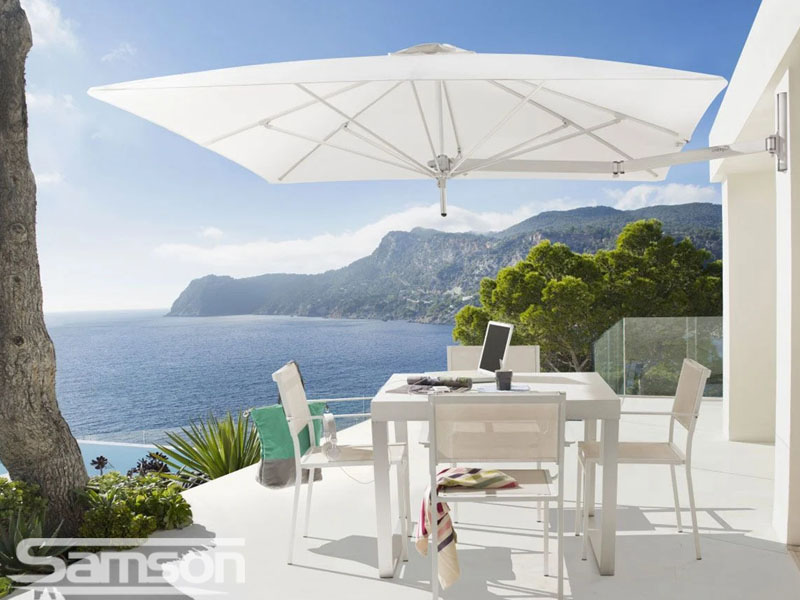
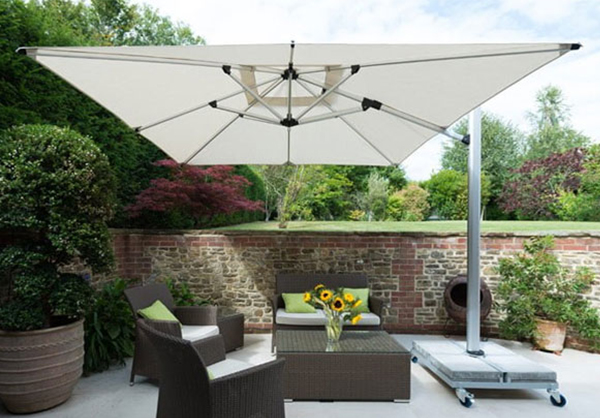
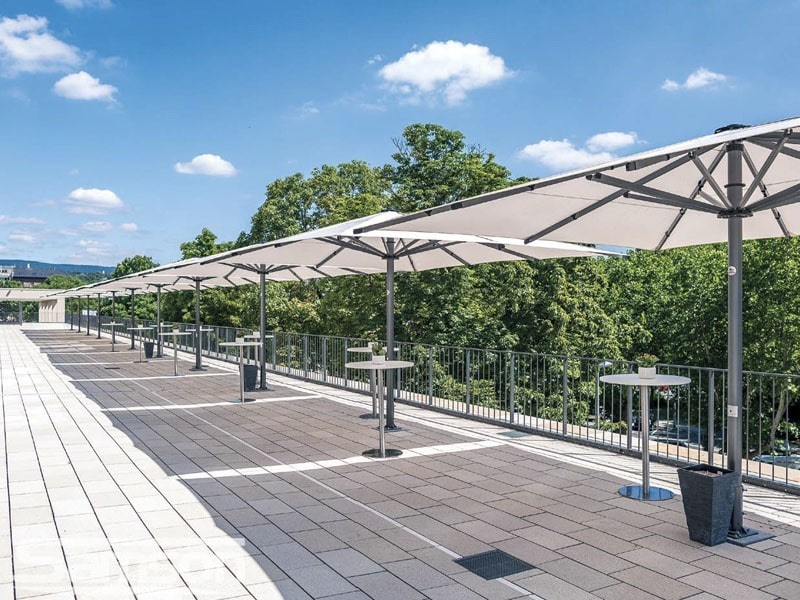
This may be the simplest solution coming up in your mind. Parasols using waterproof or water resistant fabrics will of course protect you from falling rain. We can supply from smaller and standard sizes to very large sizes of parasols for domestic and commercial use. For the best overall stability and strength, we recommend centre pole supported ranges.
Suggested products:
Models from Tradewinds offer protection but there is also our premium May collection, parasols from a dedicated German manufacturer for domestic and commercial use.The ultimate parasol for sun, rain and wind speeds over 100km/h is the Vortex…
Designed and manufactured in the UK with a wide choice of shapes and sizes this is the ultimate parasol for all year round.
Glass Verandas
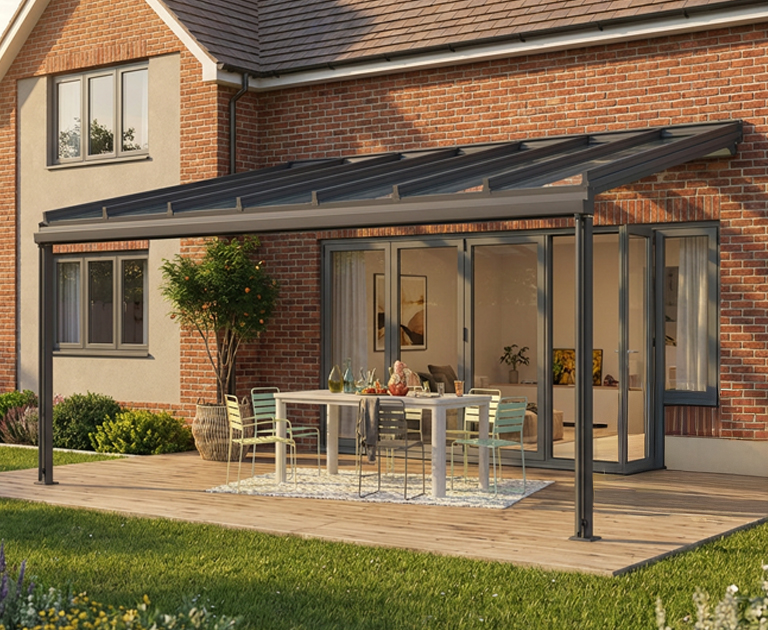
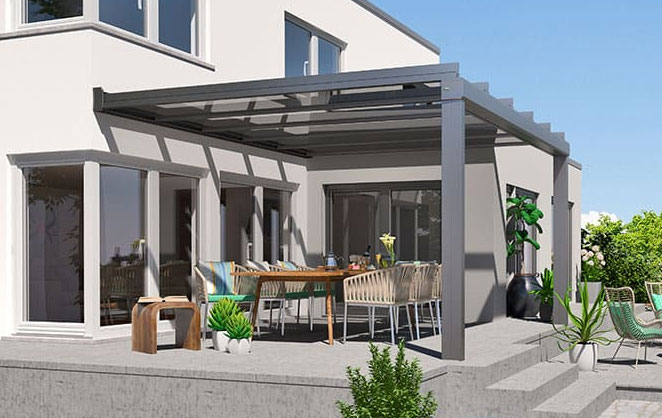
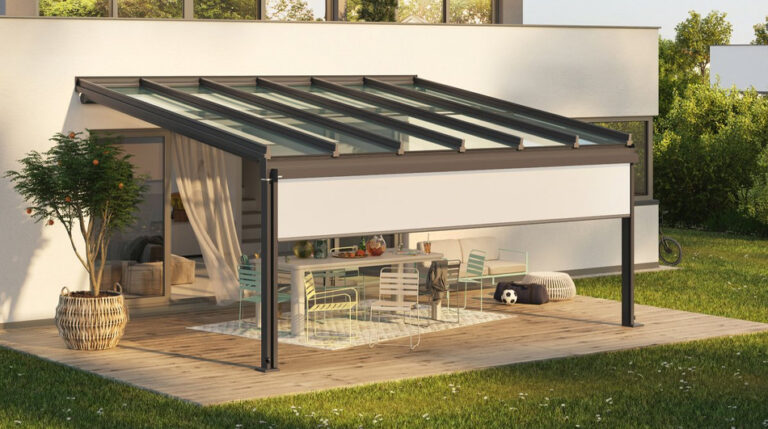
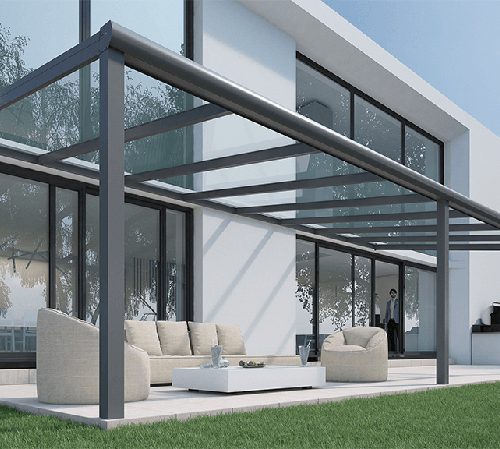
For a truly outdoor weather solution, a fixed aluminium structure using large glass panels in the roof sections and providing 100% water proof rain protection from above.
The glass veranda varieties are very customisable to fit your outdoor layout, whether you prefer a wall mounted sloped design, a flat roof configuration or a free standing set up.
The integrated rainwater gutting system, which directs rainfall from the roof through unseen downpipes, makes this structure even more functional. This helps to keep your patio or deck area dry and avoid splashing water.
This is generally believed to be the perfect weather protection solution for the UK weather amongst specialists, but only if you also include a retractable fabric blind with the glass to provide sun shade too, for use in the hotter months. Extend the fabric awning when it is hot and sunny and have the clear glass roof for the rainfall, all collected and drained away at low level… Perfect!!…..
Additionally, you can add sliding glass walls or vertical blinds to the structure for increased comfort, which will protect you from wind and driving rain. No matter what the British summer throws at you, this structure is perfect for enjoying the great outdoors. You can even sit back and watch the rain fall from the comfort of your dry, shaded sanctuary.
Retractable Pergola Awnings
The pergola awning system was introduced in the UK around 2009 as a made to measure retractable weather protection system offering far higher levels of wind stability than a normal folding arm awning could ever achieve, with a tighter fabric canopy because of the framework, which also meant it could deal with rain better too.There are two types of distinctive pergola fabric awning systems generally. One using an awning fabric and rolling the fabric in and out like a huge roller blind system with tracking and another, using thicker, triple layered fabric which folds in and out under the framework. Both these systems use electric motor drives as standard for the fabric cover. You can have wall mounted or free standing models as required.
A key factor for the fabric pergola is letting natural light still come underneath the covered area.. A huge factor for keeping the outdoor covered area feeling light and airy and a desirable place to spend time beneath in any weather..
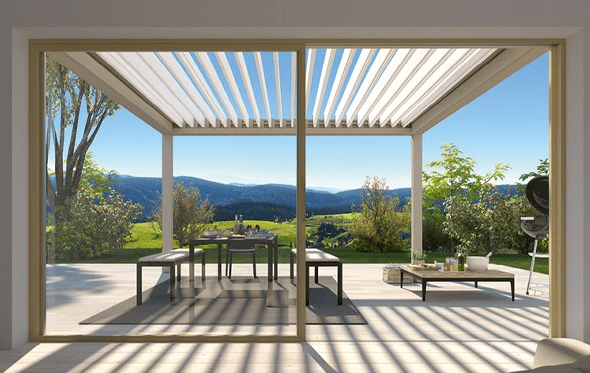
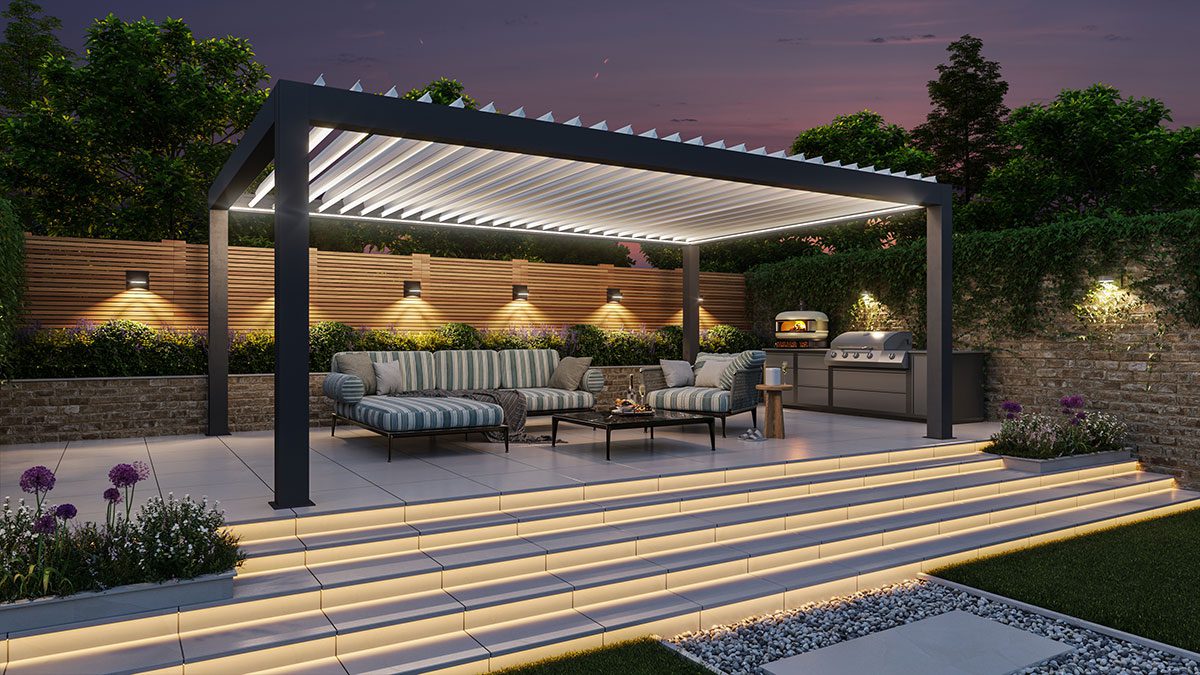
Louvered Pergolas
This product has stormed onto the UK market in the last 5 years from other countries, however you need to be aware that many models being offered are more sun shade orientated and are coming from manufacturers in hot countries, where sun shade is all that is required and rainfall protection is maybe limited depending on the drainage system size and how the blades deal with the rain too.
Be aware that any louvre roof system will always cut out all natural light when closed against rain. Undeniable but relevant to many people when fitting to your home directly as it will cut out natural light, potentially even with the blades opened
A louvered pergola structure which has been designed to deal with the rain and sun means aluminium blades which connect and seal with each other, but then enhanced rainwater drainage, with sufficient drainage capabilities for heavier rain in the perimeter channels and larger size of downpipe to take water to lower levels.
A dry and comfortable outdoor space can turn your garden into your favourite summer destination. Whether you decide on retractable awnings, glass verandas, modern pergolas with waterproof canopy, or an umbrella, make sure your space reflects your style while providing weather protection. Still have questions? Speak with our team today to have an informal chat and get prices instantly from us.
There are many other options with bespoke shapes and functionality and the larger you go the more likely planning permission would be required.
At Samson Outdoor Living, we complete a full comprehensive survey for our customer before adding a pergola, making sure it complies with local planning permission rules. The right pergola is not just about style and function – it also needs to meet height, size and placement regulations to avoid potential issues. Thus, if you have any questions, contact us today so we can help you choose a product that aligns with planning guidelines and keeps your project hassle-free.
Whether you’d like to create an outdoor sanctuary or simply provide sun shade and UV protection during a family gathering meal, a pergola structure can bring your vision to life as well as offer an all-season oasis, even with British weather. However, one of the most common questions we usually receive is that if a pergola installation needs planning permission?
In short, most pergolas do not require planning permission. However, there are a few exceptions. In this article, we will go over the requirements for pergolas to help you decide whether you need a planning permission.

The size and type of pergolas will affect if you need planning permissions. If your pergola is small, standard sized designed for residential gardens, it should be fine.
Following the general rule from 1st October 2008*, pergolas and other garden structures are generally exempt from seeking planning approval as long as the following requirements are met:
1. No structure forward of the principal elevation fronting a highway.
2. It must be one story, with a maximum eave’s height of 2.5 metres and a total height of no more than or equal to 4 metres for a pitched roof or 3 metres for any other type of roof.
3. The maximum height can be more than 2.5 metres within 2 metres of a boundary.
Planning permission is probably required if the pergola you expect is larger than these and enclosed by walls and a roof. This is due to the fact that it can be considered as an expansion of your property. However this a very grey area in terms of whether the structure is a ‘temporary’ structure or not. All these pergola systems are designed for outdoor use and do not require foundations as used in normal domestic house building or indeed damp proof floors and building control sign off.
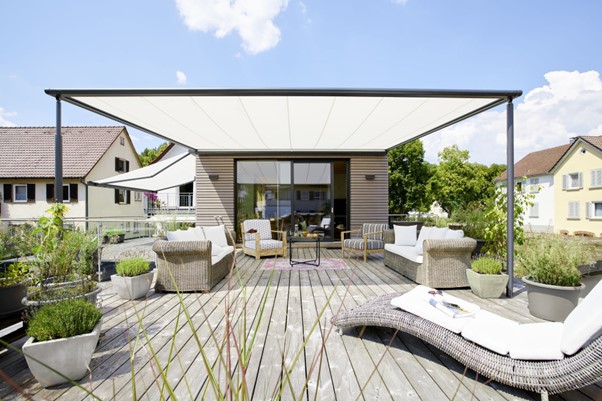
You will most likely need planning approval if you live in a conservation area or if the structures will be built on the side of your house between the house and the boundary. Both conservation areas and the side spaces between homes are locations where councils want to strictly control development, therefore, a pergola would probably need approval first.
Similarity, if your property is a designated listed building, you will need planning authorization. To maintain the historical integrity of a listed building, permission is required for any external changes. Pergola installation would be subject to listed building rules since it would be considered an external change.
CHOOSE THE RIGHT PERGOLA FOR YOUR GARDEN
The word and definition of ‘pergola’ has significantly evolved in the last five years in the UK.
Originally we only ever heard the term referring to a timber structure used in gardens and terraces for light sun shade and growing various climbing plants up and along the roof beams. It defined an outdoor seating area for relaxing and enjoying outdoors
Now however, whilst the intended purpose may be similar, the term ‘Pergola’ refers to various aluminium and steel structures with integrated fixed or retractable roof systems which can offer far greater performance. These can be structures with awning fabrics, triple layered waterproof fabrics, rotating aluminium blades and even glass. With their intended use, they have effectively become more like the definition of a ‘gazebo’ for their function.
Pergolas in 2025 are being used to create defined outdoor spaces with either sun shade or rain protection or both of course, with even further weather protection from infilling one or more sides of the structure..
So, which pergola is right for you?
Basic Sun Shade
A wide range of sloping or flat roof structure pergolas with retractable, outdoor specification fabrics. The most basic systems just slide back and forth with a pulley system and can be manual or electric operated.
Sun Shade and Light Rain
More advanced pergola systems, with far higher wind ratings, operate in and out of a closed cassette under great tension and some models will be zipped into the side channels for 4 sided fabric tension.. This tension provides greater wind ratings and also ensures when used in rain the weight of the rainwater doesn’t sag the fabric and cause water pooling and damage on the cover.
Sun and Rain (with wind protection options)
Many systems exist for rain protection, with and without built in rainwater guttering.
The structures are usually stronger and can also incorporate additional products to the sides for protection against wind and driving rain.
Fabric roof systems retract where louvre bladed systems generally do not, although there are some models which do retract to expose around 80% open clear roof.
Think carefully on louvre bladed systems as when being used for rain protection they are totally closed and act like a blackout blind blocking all natural light, where fabric roof systems can let good level of light through special fabrics designed for this purpose whilst still 100% waterproof. This can make the area underneath very pleasant or very dark.
There are many other options with bespoke shapes and functionality and the larger you go the more likely planning permission would be required.
At Samson Outdoor Living, we complete a full comprehensive survey for our customer before adding a pergola, making sure it complies with local planning permission rules. The right pergola is not just about style and function – it also needs to meet height, size and placement regulations to avoid potential issues. Thus, if you have any questions, contact us today so we can help you choose a pergola that aligns with planning guidelines and keeps your project hassle-free.

Wellingborough Northamptonshire, NN8 4BH
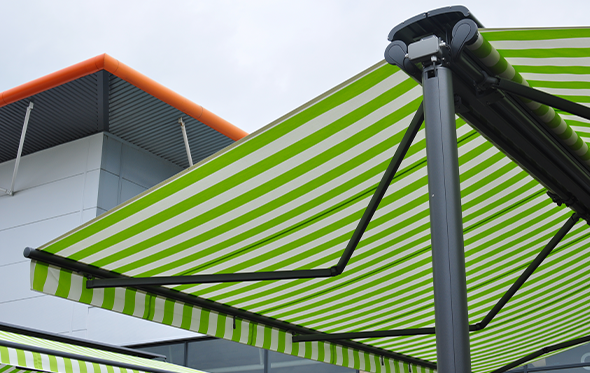
The markilux Markant on display with a recent installation here at our showroom.
Benefit now from more clients sitting down or being barflowers in your venue!
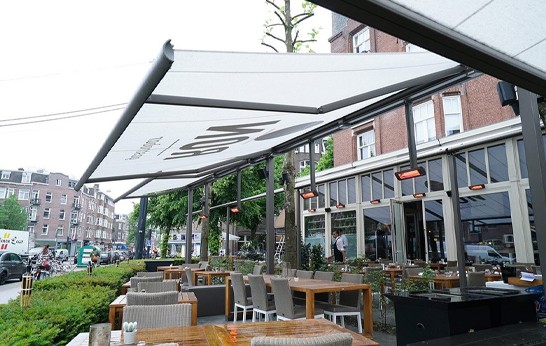
Make the most of uncovered or unused outdoor space, this beautiful installation is suitable for education, bars, restaurants, cafes, clubs, retail, sports venues and hotels. Profit from the extra space created, extra seating provided, extra revenue per year!
Comfort, beautiful aesthetics, ambient atmosphere, all year round space!
More space = more sales – people are drawn outside, they want to enjoy the light, fresh air and space.
Benefit from this strong trend and create an attractive outdoor area using products that offer all year round protection. The advantage: your guests can stay outdoors for longer, even in not-so-mild winters. Increase your dining space and your sales as a result!
By extending your hospitality you will attract more customers, protect guests from weather, enhance business branding. Ask us about placing your logo on this product.
Come and see it for yourself.
Book a survey at your convenience by calling 01933 448 844
Markant stands proudly on 4 posts covering an area of 6m x 6m, or 36m²
For an area of 36m² prices starts at £14k excluding VAT excluding Installation.